
 English
 Español
YOUNG AND ARTISTIC: Rafa and the Saxophone
especiales
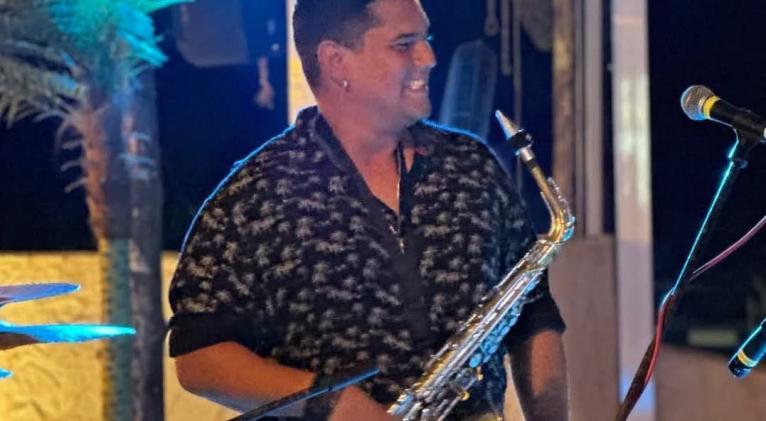
Rafa, as his friends call him, was born in Guantánamo, and that's where his love affair with music began. And, well, like almost all true loves, it gave him a bit of a hard time at first: he performed in second grade he entered elementary school, but didn't get a place for any of the instruments in the so-called "long careers" (piano, violin, viola, and cello).
In fourth grade, he changed schools—a fairly common odyssey in the provinces—to be able to choose certain instruments for which he has the physical aptitude or vocation; they simply aren't available in the municipality where he actually lives. Anyway… that's how the story and our conversation with Rafael Ramírez Martínez, who is currently part of the group Arnaldo Rodríguez y Talismán, began.
—Why did you choose the saxophone? When you entered elementary school, were you already interested in this instrument, or was it—let's say—"the one you got"?
—The saxophone was actually given to me; I didn't ask for it or anything like that. I didn't even know what a saxophone was at that time. It was at school that I learned about it, what it was, what it sounded like, and who the saxophonists were.
—Musicians choose their careers very young; around nine years old, they have to make a decision that the rest of us can postpone until we're about 18. At what point during that long period of study would you say you definitively fell in love with the saxophone?
—In fifth grade, my first year with the saxophone. At first, I was a little hesitant because I didn't know anything about it. I hadn't seen its importance; I'd think, "Well, what can I do with this?" Until I started listening to music and realizing, "Hey, of course, that's a saxophone." I began to recognize it in music, listening to orchestras, watching television… My mom would say, "Look, a saxophone!" That's when I started to see and understand what a saxophone was like, how it worked, and I fell in love with how wonderful it is to play it and the number of things you can do with a saxophone.
—What are the biggest attractions you see in it?
—Its huge capacity to blend into any kind of music; you can put the saxophone anywhere and it will shine. In any space, with any type of music, it will fit in perfectly, to the point that I've even played with the saxophone in mariachi bands. I used to play with a mariachi band in Guantánamo; we were all young guys, and because we didn't have a trumpet player, one day I said to the others: "Look, we can try the saxophone," and they said: "Sure, let's see what happens." And when we played with the saxophone, well... to this day, that mariachi band still uses the sax; they never used the trumpet again. The saxophone fits in anywhere, and when played well, beautifully, it captivates any heart.
—What challenges did studying the instrument present?
—The biggest challenge was achieving commitment. You start very young, at 10 years old you don't really understand that you already have a career in your hands, that you already have responsibilities with that career. And so, my biggest challenge was that, being able to take on the responsibility and the dedication I needed and say: I'm going to achieve this, I can achieve better things, I can keep growing.
"That was hard for me. The truth is, I'm eternally grateful to my mom and my teacher René, because it was very complicated: I had distractions from my friends playing games, the computer, the Atari, and as I got older, I wanted to go out, I wanted to do things, and I had to sit down and study the saxophone."
—You mentioned that you played in a mariachi band. How much have you been able to experiment with the sax in different genres and formats?
—With the saxophone, I've played rock, mariachi, timba, boleros, mambo; I've played in very diverse formats, even improvised ones. I've experimented a lot with the instrument because, like I said, I'm always up for new things. Wherever they say, "We need a musician," I'm a saxophonist. But if they don't want a saxophone, it doesn't matter, but give it a try, see if you like it. With that mindset, I've managed to get into almost every place.
—What else do you dream of doing with the saxophone?
—My real dream with the saxophone is to be able to play in every place where music can be made without hearing, "You can't play the saxophone here because this is a flamenco venue." Okay, it doesn't matter, I want to play flamenco with the saxophone too. My real dream, my ambitious dream with the sax, is to achieve that: to be able to play anywhere they let me play the saxophone, and for people who might not know it to realize how amazing that instrument is.
—Who have been your role models as instrumentalists?
—The first saxophonist I ever heard was Kenny G. At that time, when I was trying to figure out what a saxophone was, who played it, where I could find out, someone sat me down and said: look, don't get so caught up in trying to find where to listen to the saxophone, just sit down and watch the televised lessons; all the music used in those lessons features saxophone, almost all of it is Kenny G. So I listened and thought: wow, but yeah, I've been listening to him for as long as I can remember, and I hadn't even realized it. A friend who was studying with me practically copied me. I listened to Kenny G's entire discography all the time, because I love how he plays. Later, as I grew up, I discovered other styles, other people, other ways of playing, and that's when I started to find out about artists like Charlie Parker and Coltrane, more focused on jazz. Then I discovered César López in Cuba, who is a "monster"; I saw Paquito D'Rivera, who is another "beast"; so, more or less, those were the saxophonists I really listened to closely, the ones I studied.
—You studied popular saxophone at ISA. What took you to that field?
—First, I found great value in the fact that, for the first time, at ISA and in arts education in general, they were showing particular interest in popular music, both Cuban and foreign, and that was a big factor in my decision to get in. I said: I have to be there, I want to be one of the first graduates. In fact, if I graduate, I'll be the first person in the country to graduate with a degree in popular music, the first person with a bachelor's degree in popular music. That's really when I saw the importance of the degree, the fact that it was being offered for the first time, and I was very interested in being part of that first time.
—You also work as a teacher. Do you enjoy teaching?
—When I was offered the opportunity to teach band at Guillermo Tomás, to work with the jazz band, at first I was a little afraid, because I'm really bad at teaching, at delivering classes; I have very limited patience in that regard. My mom was the one who kept saying to me, "Hey, go for it, try it," and I kept saying no, I can't sit in a classroom full of kids. Then a friend of mine, a teacher who's like a mother to me, said, "Give it a try. Knowing you, I know that the day you try it, you're going to love it." So I went for it, I listened to her, I thought, "Two of my mothers can't be wrong." I agreed, and I swear it was amazing. I mean, my first class with the kids was incredibly nerve-wracking, but at the same time, I enjoyed it so much because most of them knew me, they'd seen me play, and I realized that I was like a role model, they admired me. Then, when I started getting to know them, listening to their stories, how they live, how they study, how they prepare, what they think, I loved it. I love it every time I arrive at the school and they're waiting for me, calling out, "Teacher, teacher!" and the barrage of questions begins. Everyone wants to ask me what they want to know: how to do this or that, when you're going to take me to one of your concerts, "I want to play with you!" They drive me crazy, but really... I loved it because I also felt a strong connection with many people who, from a young age, are interested in learning and growing. It reminded me a lot of when I was a child, the same way—hyperactive and always wanting to be taught by adults. I truly enjoy teaching.
Translated by Amilkal Labañino / CubaSí Translation Staff







Add new comment