
 English
 Español
José Antonio Kast Wins Presidency in Chile, Promising Security and Tight Border Controls
especiales
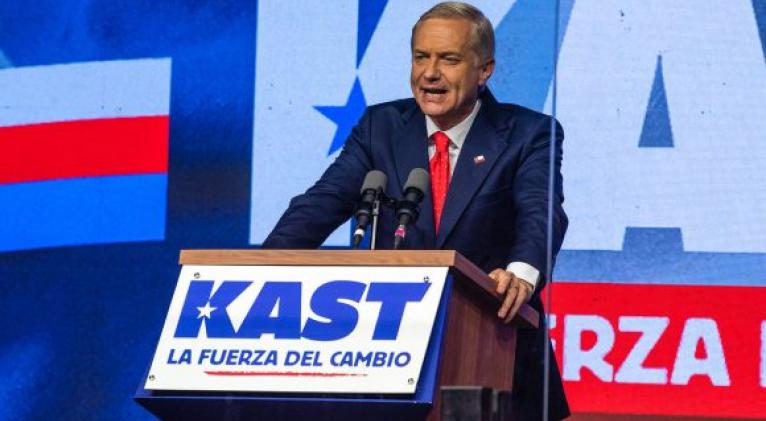
On Sunday, December 14, ultraconservative candidate José Antonio Kast was elected president of Chile, marking the country's most significant political shift to the right since its return to democracy 35 years ago. With 99.86% of votes counted, Kast secured a decisive victory with 58.16% of the vote, defeating leftist Jeannette Jara, who received 41.84% .
Election Results and Significance
Kast's win represents a substantial consolidation of right-wing support in Chile and Latin America. The election saw a record-high turnout of approximately 85%, driven by the first implementation of mandatory voting . Kast's margin of victory—over 16 percentage points—is the second-largest in a presidential runoff since 1990 .
Key Factors in Kast's Victory:
-
Coalition Building: After placing second in the first round, Kast secured endorsements from other right-wing candidates, including libertarian Johannes Kaiser and traditional right figure Evelyn Matthei .
-
Voter Concerns: His campaign successfully capitalized on voters' primary concerns: security and immigration .
-
Broad Support: He gained significant support from backers of third-place first-round candidate Franco Parisi .
Core Policy Agenda: A "Government of Emergency"
In his victory speech, Kast framed his priorities as a necessary response to national crises, stating, "The emergency does not mean authoritarianism at all. It means a very simple thing: priority, urgency, and compliance" . His administration's initial three-month plan, dubbed "Recover Chile," focuses on four key areas :
| Policy Area | Key Proposed Measures |
|---|---|
| Security & Borders | A "Comprehensive Security and Border Control Law" to grant expanded powers to the military and police in border regions; construction of a 5-meter-high border wall with drones and electrified fences; a goal to reduce illegal crossings by 40% in the first 90 days . |
| Immigration | Immediate expulsion of migrants who cross illegally; sanctions for NGOs that "hinder" deportations; denial of rights like sending remittances and access to public healthcare (except emergencies) and education for undocumented migrants . |
| Fiscal Reform | A "Zero-Based Budget" requiring all public spending to be justified anew; a planned $6 billion cut to public spending over 18 months; a progressive reduction of the corporate tax rate from 27% to 23% . |
| State Modernization | Merging or eliminating government ministries; a hiring freeze and strict restrictions on public administration spending . |
Political Background and Reactions
Kast, a 59-year-old lawyer and former congressman, is the founder of the Republican Party. This was his third consecutive presidential bid, having lost to the outgoing progressive president, Gabriel Boric, in 2021 . His political rise has revived debate about his family's past; his German-born father was a member of the Nazi Party, and Kast has expressed sympathy for the former military dictatorship of Augusto Pinochet .
His opponent, Jeannette Jara, quickly conceded defeat. On social media, she wrote, "Democracy spoke loud and clear. I have just communicated with President-elect José Antonio Kast to wish him success for the good of Chile" . In a subsequent speech, she pledged to be a firm opposition, stating she would support actions beneficial to the country but firmly oppose any perceived setbacks .
Outgoing President Boric invited Kast to the presidential palace to begin an orderly transition . Internationally, congratulations came from other right-wing leaders in the region, including Argentina's Javier Milei and Ecuador's Daniel Noboa, as well as from U.S. Secretary of State Marco Rubio .
Despite a strong mandate, Kast will govern without an absolute majority in Congress, requiring him to build alliances to pass his legislative agenda . He is scheduled to be inaugurated on March 11, 2026 .






Add new comment