
 English
 Español
Latin America: What Happened This Weekend?
especiales
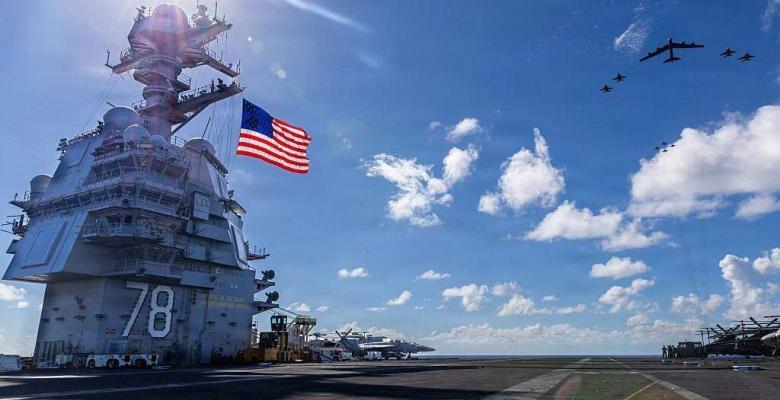
The period from November 14th to the close of this assessment reveals an accumulation of news that transcends the daily and the ephemeral. Presidential and parliamentary elections in Chile, a referendum in Ecuador, violence against the government of Claudia Sheinbaum in Mexico, and, as could not be missing, the evolution of the combat readiness alert against Venezuela.
A Tense Caribbean and the Specter of Invasion
The eventual invasion of Venezuela undoubtedly occupies first place in terms of political gravity. In just 72 hours, comments from high-level U.S. government officials surfaced, all accentuated by an increase in a media avalanche, all aimed at exerting greater pressure, for now in the "psychological" phase, in favor of a regime change—that is, the destruction of the Bolivarian Revolution.
On the physical terrain, the arrival of the supercarrier USS Gerald R. Ford to the Caribbean was finally shown. Along with its escort, it adds some 15,000 deployed personnel and, consequently, raises daily expenses to 200 million USD; all this to continue sinking small boats, killing nameless fishermen or drug traffitters. To make things clear, Secretary of the Army, Dan Driscoll, stated that "we are ready" (the soldiers) to fulfill the missions decided by President Trump. This declaration was associated with the prior announcement by Driscoll's boss, Pete Hegseth, Secretary of War, who briefly exposed on social media platform X the start of "Operation Southern Lance," under the responsibility of the Southern Command.
Not to be left out of this clamor, Mr. Rubio revived the declaration of the nonexistent "Cartel of the Suns" as a terrorist organization, something that will be made firm on the 24th of this month; which, according to his arbitrary understanding and in line with his twisted personal agenda, would add greater legality to attacking Venezuela. This is how it works: Officer Rubio declares whoever he sees fit guilty and executes the sanction, without showing the slightest proof.
As can be seen, there was much hustle and bustle in the corridors of power in Washington. And when everything was ready for combat, for some inscrutable reason, the boss Trump poured a bucket of ice water on the participants of the verbal attacks; he again evaded a response about his plans towards Venezuela, and even affirmed that there could be talks with the elusive Maduro.
International Rejection and Political Confusion
In the meantime, rejection on the international stage is becoming increasingly obvious. These days, the "allies" who met in Canada in the G7 format bluntly told Mr. Rubio to his face, with diplomatic manners, that they do not accept the abuses his country is committing in the Caribbean. Secretary Rubio, with less educated gestures, responded by insisting on the concept of mare nostrum of the Caribbean or the Monroe-ism that characterizes him.
In accordance with the above, the United Kingdom went further and announced that it will no longer provide intelligence information to the USA on this subject, to which a similar decision from Colombia was added, which is said to guarantee the Pentagon 85% of this type of information on the operational situation in the Caribbean.
The most measured interpretation of this "confusion" points to showing that there is no necessary consensus to treacherously attack Venezuela; not even to communicationaly manage what they plan to do. Many missiles, but also much fear of the political consequences of a military adventure against the South American country.
Preliminary Conclusion. It would not only be naive but even perverse to assume that the dangers facing the Bolivarian Revolution have subsided, a consideration evident from the magnitude of the threat; but from a political point of view, the matter here is to insist that the US has no right, nor any justification, to violate the national sovereignty of any country, especially one member of CELAC.
Electoral Results Highlight Continental Left's Challenges
Amid this tense context, two electoral events took place, whose results serve to understand the political reality in the Region. In both cases, and despite apparently diverse and favorable results, it must be affirmed that they showed the weaknesses of the continental left.
Beginning with what happened in Chile; here the candidate Jeannette Jara obtained 26.45%, while the second in the vote, José Antonio Kast, took 24.46%, showing the level of polarization that divides the Chilean electorate, of which no less than 85% voted, the highest according to historical standards. Due to her communist origin, although Jara represents a possible continuity of Boris's progressive government, she ultimately conveyed to the electorate being at the opposite extreme from Kast, who is declared ultra-right.
Although it is still premature to advance considerations about what will happen in the second round, scheduled for December 14th, a first reading suggests that Jara will have a difficult time surpassing, in such a climate, the eventual union of the other candidates, who express right-wing positions, including another aspirant also of ultra-ultra-right (ultra squared), which, added to Kast, comfortably exceed the 50% of votes needed to win. It is known that this type of summation cannot be done mechanically, as potential voters who do not vote for the new proposal are left along the way, but in the case of the mentioned right-wing and ultra-right-wing candidates, it is very unlikely that they would now support Jara.
We will have to wait for December 14th, but, returning to the attempt to offer a first reflection, frankly Jara could not connect sufficiently with deep Chile, and something happened along the way that they failed to convince. Not so long ago, back in September 2022, when Boris's government had just begun, the left suffered an instructive defeat when trying, through a plebiscite, to send the still-standing Pinochet-era constitution to the trash. That defeat perhaps now shows its strategic effects. Many hope that these lessons are finally taken into account and guarantee the also strategic victory for Jeannette Jara, whose consequences would transcend her borders.
Regarding Ecuador, the rejection of what President Noboa presented in the referendum can be said to have been crushing; the joy of those who rose against the installation of foreign, specifically US, military bases, and other government proposals is immense. However, one thing is clear regarding these results. They show that the imprint of the Citizens' Revolution project is still in force, obviously embodied in the constitution that the current Ecuadorian government wanted to transform.
It has been debated, some experts even claim to have proven some type of fraud, which guaranteed the current president continued in the Carondelet Palace (seat of the national government) in the elections last April, but it is obvious that errors or insufficiencies prevented a united opposition from achieving a sufficiently demolishing victory to overcome that alleged fraud or Noboa's electoral capacity.
Violence in Mexico and a Region in Summary
As anecdotal but in perspective very relevant, the attempted assault on the National Palace, seat of the Mexican government, made news, presented as a rebellion of the so-called Generation Z, young people born between 1997 and 2012. On that occasion, it began as a peaceful march, curiously mostly of adults over 30, not "Z," who demanded the need for greater security and the fight against organized crime, a matter on which the current Mexican federal government has given ample evidence of working on. The march turned into a pitched battle and an attempt to assault the Palace by a small group of hooded individuals, concerned with hiding their identity, which, among other things, caused injuries to more than 20 law enforcement officers, as well as damage to the protective structures of the Palace.
Political analysts knowledgeable of the event mostly point to giving it a politicized character with destituent pretensions against President Claudia Sheinbaum, overlooking, of course, that she enjoys one of the highest popularity levels on the continent, around 70% of her population.
The events of this weekend, with just about 45 days left until the end of 2025, seem to gather in a few hours how politics has unfolded in our Region throughout the year. To wit: renewed imperial aggressiveness, brought to the point of an imminent invasion of a Latin American country; electoral results that challenge the left and progressivism; and to top it off, a veiled coup attempt, wrapped in the gift paper of the "Z" type, if the metaphor is understood, against one of the presidents most beloved by her people.
Insisting on Politics
Insisting on politics often turns out to be necessary and inevitable. So if one looks in the hidden corners of these situations for Secretary Mr. Rubio, it is not at all redundant; he ultimately has the mission of ensuring that his boss Trump, embarked on trying to rule the world, at least achieves it in Our America; but history, with its proverbial sense of justice, will put this outdated aspiration in its place.
Translated by Sergio A. Paneque Díaz / CubaSí Translation Staff





Add new comment