
 English
 Español
Trump's Pardon of Juan Orlando Hernández Exposes "Inconsistency" in His Purported War on Drugs in Latin America
especiales
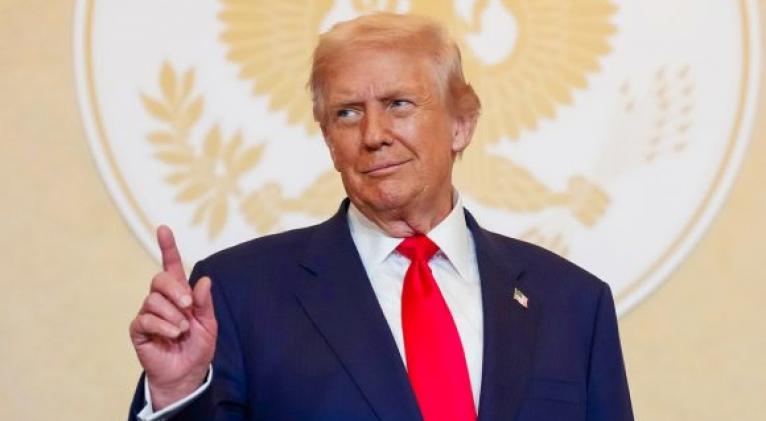
Donald Trump, the U.S. president who claims to be combating drug cartels in Latin America, has freed from prison someone convicted of leading an entire "narco-state" in the region.
Juan Orlando Hernández, the former president of Honduras serving a 45-year prison sentence in the U.S. for drug trafficking, received an official pardon from Trump on Monday night and was released, according to multiple sources.
The U.S. Federal Bureau of Prisons website indicates Hernández left the Hazelton prison in West Virginia this past Monday, where he was serving the sentence issued last year.
"My husband Juan Orlando Hernández is once again a free man, thanks to the presidential pardon granted by President Donald Trump," wrote the ex-leader's wife, Ana García, on her X social media account on Tuesday.
Trump had foreshadowed his decision on Friday, as his controversial military offensive against alleged drug traffickers in Latin America has left at least 83 dead in attacks on boats in Caribbean and Pacific waters.
The president stated on Tuesday that the U.S. would also begin conducting "ground attacks" that could target Venezuela or any country it considers produces or sells illegal drugs to the U.S.
His administration maintains these lethal actions are legal, in defense of Americans who could be poisoned by illicit drugs.
However, some experts warn that attacks on civilians may constitute illegal extrajudicial killings, while others suspect the U.S. purpose is to pressure Venezuelan President Nicolás Maduro to leave power.
Several analysts, and even members of Trump's Republican Party, see a paradox between these hardline actions and the pardon of someone who helped smuggle over 400 tons of cocaine into the U.S., according to the country's own prosecutors.
"It really creates an inconsistency: we see lethal force used against alleged low- and mid-level traffickers at sea," and "a head of state convicted of enabling the same [drug] routes being treated very differently," notes Rebecca Bill Chavez, president of the Inter-American Dialogue, a regional think tank in Washington.
"This makes the counternarcotics mission, or at least its narrative, appear much more selective and politically motivated," she tells BBC News Mundo. Chavez served as U.S. Deputy Assistant Secretary of Defense for Western Hemisphere Affairs from 2013 to 2016.
"Under Their Noses"
Hernández was extradited to the U.S. after leaving power in 2022 to stand trial for conspiracy to traffic drugs.
The evidence presented against Hernández in a New York federal court last year was sufficient for the jury to unanimously declare him guilty.
In fact, the trial of JOH (as he is also known by his initials) served as a sort of X-ray of what prosecutors defined as a *"Latin American narco-state in the 21st century."*
While publicly presenting himself as a Washington ally during his presidency from 2014 to 2022, Hernández privately spoke of "shoving the drugs right up the noses of the gringos," according to one witness in the case.
The same witness, a former Honduran accountant presented under a pseudonym and protected by the U.S. government, testified to seeing Hernández receive suitcases of money from drug trafficker Geovanny Fuentes Ramírez.
Alexander Ardón, another Honduran imprisoned for drug trafficking, testified that he financed Hernández's campaigns and that, with help from Honduran power structures, moved tons of cocaine in partnership with criminals like Joaquín "El Chapo" Guzmán, the Sinaloa cartel leader serving a life sentence in the U.S.
According to Ardón, "El Chapo" delivered one million dollars to the ex-leader's 2013 presidential campaign via Tony Hernández, a former congressman and brother of Juan Orlando, who is also serving a life sentence in the U.S. for drug trafficking.
Drugs crossed Honduras by land, air, and sea en route to the U.S., with government-paved roads in remote areas to facilitate transport, landing strips, strategic ports controlled by narcos, and state security forces that in reality protected the illicit shipments.
The trial also revealed glimpses of how violence skyrocketed in Honduras, giving it the world's highest homicide rate in the past decade, according to United Nations data.
Devis Leonel Rivera, a former leader of the Honduran criminal group Los Cachiros also imprisoned in the U.S., testified to having bribed Hernández and committed 78 murders by his own count.
"A Horrible Message"
With warships and fighter jets, Trump maintains an extraordinary military presence in the Caribbean for what he defines as counternarcotics actions.
Hernández has maintained his innocence from when he was charged by the U.S. and extradited to New York in 2022 until now.
In a letter sent to Trump in October, he claimed to be a victim of "political persecution" by the previous U.S. administration of Joe Biden.
"Like you, I was recklessly attacked by radical leftist forces who could not tolerate change, who conspired with drug traffickers and resorted to false charges," states the missive from the ex-president disclosed by U.S. media.
Following the pardon, Trump said he felt "very good" about his decision and referred to the case against Hernández as "a horrible witch hunt" by the Biden administration.
Hernández "was the president, and there was some drugs being sold in his country, and because he was the president they went after him," Trump told the press on Tuesday.
However, former Biden administration officials, like his National Security Council Senior Director for the Western Hemisphere, Juan González, have indicated that much of the U.S. criminal investigation into Hernández occurred during Trump's first term (2017-2021).
The pardon announcement prompted questions from the Democratic opposition and within Trump's own Republican Party.
"Why would we pardon this guy and then go after Maduro for trafficking drugs into the United States?" Republican Senator Bill Cassidy asked on X on Sunday.
Another Republican senator, Thom Tillis, stated that the pardon for Hernández "sends a horrible message."
"It is confusing to say, on the one hand, that we should potentially even consider invading Venezuela for drug trafficking and, on the other hand, let somebody go," Tillis told reporters on Tuesday.
Trump accuses Maduro without evidence of leading one of the Latin American drug trafficking groups he has designated as "terrorist," the Cartel of the Suns—a claim the Venezuelan leader rejects and considers a pretext to attempt to overthrow him.
Washington considers Maduro an illegitimate president, and during a recent phone call, Trump reportedly gave him an ultimatum to leave Venezuela by last Friday, according to U.S. media.
Since the start of military attacks against alleged drug traffickers in the Caribbean in September, several experts have warned that the most dangerous illegal drug reaching the U.S. is fentanyl, which has never been mass-produced in South America.
Christopher Sabatini, Senior Research Fellow for Latin America at the influential British think tank Chatham House, believes for Trump this "is not actually about a war on drugs."
"If it were, he would be directing his forces elsewhere and, obviously, he wouldn't be pardoning a former president convicted of facilitating the delivery of up to 400 tons of cocaine to the United States," Sabatini tells BBC Mundo.
"This is about partisanship. It's about allies. And most importantly," he adds, "it's about coercing other governments in the region to support him."





Add new comment