
Fidel and Chávez, United by Baseball as Well
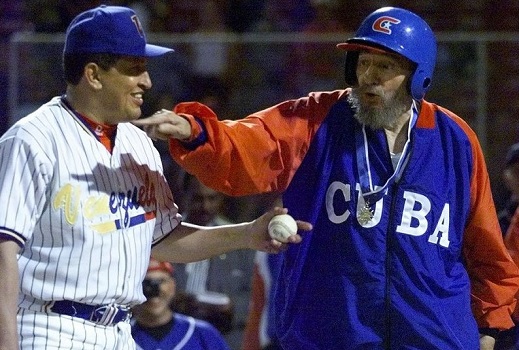
Fidel Castro and Hugo Rafael Chávez Frías were not only two presidents united as brothers in ideas and struggle; they were also bound by a shared passion for baseball.
Twenty-seven years later, people still remember that unprecedented event staged by both statesmen on November 18, 1999, when Fidel, serving as manager, and Hugo Chávez, playing as pitcher and first baseman, participated in an unusual game at the Latinoamericano Stadium.
Chávez had led the Venezuelan delegation to the Ninth Ibero-American Summit held in Havana and made a two-day state visit to Cuba, an occasion he seized to hold a fraternal baseball matchup.
At 7:45 p.m., the then-president of Simón Bolívar's homeland walked onto the field and took a full lap around it. A few minutes later, Fidel made his entrance wearing a baseball cap, receiving applause from nearly 50,000 spectators gathered in the stadium.
The visiting squad featured veterans such as Tony Armas, Jesús Cartagena, and Víctor Davalillo, while Cuba's roster included, among others, Antonio Muñoz, Víctor Mesa, Rolando Macías, Rey Vicente Anglada, and the late Pedro José Rodríguez ("Cheíto") and Lázaro Pérez, all former members of the national team.
The host squad opened with the late Alfredo Street, winner of three games at the 1961 World Championship in Costa Rica, who gave up a pair of early runs after allowing three hits, combined with an error by Cheíto Rodríguez and a ground ball by Tony Armas.
The Cuban side rallied and took the lead when Hugo Chávez, who pitched four innings, issued walks to Rey Vicente Anglada and Rodolfo Puente, while Agustín Marquetti and Lourdes Gourriel notched base hits.
Upon reaching the middle of the game, the Commander-in-Chief played a prank on the Venezuelan president by sending onto the field players from the Cuban squad that had won the championship at the Pan American Games in Winnipeg, Canada, earlier that same year.
Sporting makeshift beards and mustaches, Juan Padilla, Juan Manrique, Pedro Luis Lazo, and José Ariel Contreras took the field, but when slugger Orestes Kindelán—a player well known to Hugo Chávez—stepped up to the plate, Chávez caught on to the joke.
At the conclusion of the game, Chávez was awarded the Order of Sports Merit, the highest distinction in this sphere conferred by the Council of State of the Republic of Cuba, which was no mere protocolary gesture: the Venezuelan president was a skilled baseball player.
Beyond the scoreboard reflecting a Cuban victory by five runs to four, the event entered history as an unprecedented chapter: the matchup between two leaders of sister nations—the lands of Simón Bolívar and José Martí—meaning both teams emerged victorious.
Recalling the event in his book "Cuentos del arañero," Chávez recounted: "That night we were riding together in the car, Fidel and I, already dressed in our baseball uniforms. We stopped at the gate; we were about to enter the stadium when Fidel told me: 'My chivalry ends right here; from here on out, defend yourself however you can.'
"He had told me: 'Look, Chávez, I recommend that you score runs in the early innings.' I kept analyzing that and turning it over in my head: What could he possibly mean by that? Of course! He had the ambush set up for the fourth inning."
The next day, November 19, 1999, a few minutes before boarding the Venezuelan Air Force plane that would take him back to his country, someone asked Hugo Chávez if he would repeat his visit.
"Sure. Sure. God willing, we will be here again soon, but wherever we are, we will always be attentive to every heartbeat of Cuba, to Cuba's heart. We will be giving you a rematch next year," Chávez replied.
On October 28, 2000—coinciding with the 41st anniversary of the physical disappearance of the unforgettable Commander Camilo Cienfuegos Gorriarán, the Hero of Yaguajay—a second game was held in the South American nation.
On this occasion, the score once again favored the Cuban players, who came out on top 18 runs to six, with home runs credited to Víctor Mesa, Juan Carlos Millán, and Rolando Verde.
Before the game, witnessed by more than 30,000 spectators, Chávez bestowed upon his counterpart Fidel Castro, manager of the Cuban squad, the Order of Sports Merit, First Class, for his outstanding contribution to the development of sports on the largest island of the Caribbean.
The friendly clash turned one-sided from the very first inning, when the Cubans scored four runs off 59-year-old starter Luis Peñalver, who had played in the Major Leagues during his later years.
At the end of the matchup held at the Antonio Herrera Gutiérrez Stadium, Chávez took the ball to pitch to members of the visiting delegation.
After allowing a double and recording an out, he engaged in a duel with the Cuban president that reached a count of three balls and two strikes.
A borderline pitch that the home-plate umpire called a strike sparked disagreement from Fidel, who argued it was ball four and, far from heading to the dugout, walked down to first base, adding a playful touch to the spectacle.
Nearly seven years later, in May 2007, at the conclusion of the game between Cuba and Venezuela that closed the baseball program of the Second ALBA Games, Hugo Chávez jokingly recalled: "Do you remember that strikeout I pitched against Fidel in Barquisimeto? Well, in reality, that pitch was a ball, because Fidel never strikes out."
That remark struck me in a particular way; upon hearing it, I looked through my archives, and after seeing the abundant information I had gathered on Fidel's relationship with baseball, the idea emerged to write a book on the subject.
Translated by Sergio A. Paneque Díaz / CubaSí Translation Staff
Add new comment