
Student Participation as Young Cubans in the Revolution
De la participación de los estudiantes como jóvenes cubanos en Revolución
For the Revolution to endure, for socialism to continue to be built, and for the country to overcome this energy siege and the intensified blockade and emerge stronger, the participation of students is very important, said First Secretary of the Party’s Central Committee and President of the Republic Miguel Díaz-Canel Bermúdez at a meeting with members of the FEEM and FEU as part of the International Students’ Day commemorations.
“For the Revolution to endure, for socialism to continue to be built in our country, for us to overcome this energy siege and this intensified blockade and emerge stronger with everything we are trying to do, the participation of our students is very important,” stated First Secretary of the Party’s Central Committee and President of the Republic Miguel Díaz-Canel Bermúdez.
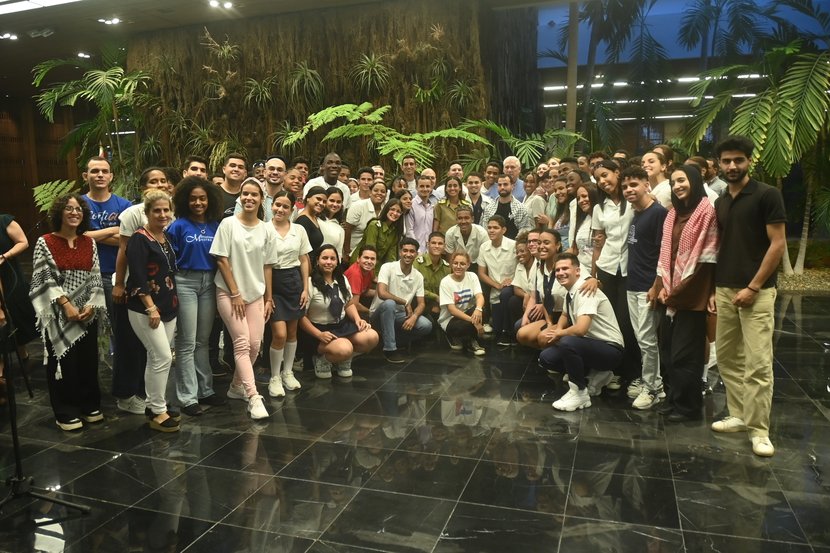
The Head of State reaffirmed this permanent principle of the Revolution before nearly one hundred middle school and university students, with whom he met on the afternoon of November 17 at the Palace of the Revolution to commemorate International Students’ Day.
After listening to and exchanging views with about twenty young women and men who wished to share their life experiences during this time in the country’s history, Díaz-Canel highlighted the contribution students are making today “from their arenas of participation as young Cubans in Revolution.”
That, he told them, has been the role of young people throughout the years, because “on a day like today, the best tribute is to participate, to think about the country, for you, as young people, to defend the country, to defend the Revolution,” the President said, after congratulating them on International Students’ Day and on being “standing firmly in the country’s priorities.”
The meeting was attended by representatives of the Federation of Middle School Students (FEEM) and the University Student Federation (FEU), from pre-university schools, polytechnic schools, and institutions of higher education, both general and those specializing in the arts, sports, medical sciences, the Revolutionary Armed Forces, and the Ministry of the Interior. Also present were members of the youth Baseball5 team, which was crowned champion at the recently held Youth Olympic Games.
The celebration, which had Palestinian students as special guests, was also led by Politburo member and Central Committee Secretary for Organization Roberto Morales Ojeda; Deputy Prime Minister Eduardo Martínez Díaz; and First Secretary of the Young Communist League (UJC) Meyvis Estévez Echeverría. Other Party and Government leaders and ministers of the education-related agencies also attended.
Studying Is Also a Contribution
In a dialogue moderated by Elisbel Durán Borroto, member of the UJC National Bureau and head of its education sector, the first to speak was Julio Ángel Maceo, national president of the FEEM. He affirmed the commitment of middle school students to the country’s tasks, in which they are protagonists in everything that falls to them, beginning with study, academic improvement, and student research.
Idanis, a fifth-year cadet at the Eliseo Reyes Rodríguez, Captain San Luis, Higher Institute of the Ministry of the Interior, explained how students at that institution are connecting with different neighborhoods in the capital as part of the Community Youth Network, and the contributions they make to social discipline, drug abstinence, and other actions tied to their specialties.
Rocío, a sixth-year cadet at the Medical University of the Revolutionary Armed Forces, described social projects in which she takes part, including support in primary schools, where they run interest groups and help educate girls and boys.
Migdalia, a medical sciences student at the Calixto García University Hospital Faculty, explained the Farmajoven initiative, aimed at donating medicines, especially to vulnerable people and the elderly. It is generating a broad solidarity movement in each community, where people not only come to the fairs the students organize in search of the medicines they need, but others are making their own donations so that the initiative continues to grow.
Alejandro, a fourth-year student at the University of Informatics Sciences (UCI), spoke about a science and innovation project, developed jointly with the University of Camagüey, aimed at teaching mathematics from a new approach and contributing to the education of new generations in the face of the advent of Industry 5.0.
Erick, a hydraulic engineering student at CUJAE, discussed the contribution of students in this faculty to finding solutions for water supply in communities in Artemisa province through renewable energy sources and other innovations.
A special moment of the meeting was led by young Palestinian Saleh Hethnawi, who arrived in Cuba in 2021 to study medicine and is close to graduating.
“Our presence here,” he said, “is not a coincidence. It is because Cuba has guaranteed the right to education to hundreds and hundreds of young Palestinians over many years, and that is something our people have always been grateful for and always will be.”
Always in Revolution
After recalling the origins of the International Students’ Day commemorations, First Secretary of the Party’s Central Committee and President of the Republic Miguel Díaz-Canel Bermúdez reviewed the history of the Cuban student movement.
It is a movement that dates back to the wars of independence, Díaz-Canel stressed, recalling that many of the nation’s founding figures were excellent students, such as Céspedes, Agramonte, and Martí.
Our students, he noted, were also part of the struggles of the 1930s against the corrupt governments of the time, as part of a movement shaped by Mella, the FEU, and the founding of the Communist Party. The students of the 1950s, the Centennial Generation, with the Revolutionary Student Directorate, were also active. Our young people were also at the Moncada, in exile, aboard the Granma, and later in the Sierra Maestra.
The Cuban President shared with middle school and university students the leading role these adolescents and young people have played since the Triumph of the Revolution and the Literacy Campaign, and at the time when the Revolution had to begin defending itself against the perverse interests of imperialism and adopt new combat techniques, which led many to join the Revolutionary Armed Forces and the Ministry of the Interior.
At the International Students’ Day gathering, Díaz-Canel Bermúdez highlighted the presence of young Palestinians studying in Cuba. “I believe,” he said in this regard, “that today Palestine and Cuba are the most notable expression of the resilience of peoples who are determined to defend their self-determination, their unity, and their principles.”
Youth Are Protagonists
In emphasizing the leading role of Cuban students in the tasks the Revolution demands, the Party’s First Secretary highlighted their participation in three fundamental priorities today: the defense of the Revolution, science and innovation, and community social work.
He explained how, in the face of the intensified blockade, the energy siege, and imperialism’s heightened rhetoric about the possibility of aggression against Cuba, the country had to decide to activate the components of the territorial defense system and the national defense system and to declare every Friday a day of defense, which students have joined in the places assigned to them.
“Preparing ourselves to face aggression is the best way to keep it away,” Díaz-Canel said. “We are not a country that is a threat to anyone; we do not attack or threaten; we are a country of peace, but we will never allow anyone to dare to occupy our land and anyone to dare to destroy the Revolution,” he affirmed.
Referring to the implementation of the 176 Economic and Social Transformations as part of this process, and to the need for them to be properly applied and begin to deliver tangible results in the lives of Cuban families, Díaz-Canel emphasized the importance of developing a student youth debate within their structures on these transformations, so that they are understood, supported, and participated in during implementation.
He explained to the young people that, of the 23 axes into which the Transformations are structured, there are several in which young people, and especially students, can be standard-bearers.
One of them, he said, is science and innovation, which cuts across all the axes. A country like ours, he argued, has to move forward through innovation and scientific research, and that is part of our tradition, because “it is a heritage of the Cuban nation that scientific thought has always been on a par with political thought throughout our history.”
And, he stressed, “who better than young people to be the standard-bearers of that scientific thought, that innovative thinking.” That, he added, must be tied to one of the fundamental tasks, one of the fundamental commitments they must take on, which is “to study, to acquire knowledge, to prepare for life, and to let that enable you to contribute to the country later. To be good citizens, good people, revolutionaries. Also good professionals, good technicians, good workers.”
As another axis that students should take on as protagonists, the Head of State pointed to digital transformation and the use of artificial intelligence, which “can lead us to processes with greater performance, greater productivity, greater efficiency, to modernize the country.”
And who better than young people, he affirmed, “the digital natives,” to drive digital transformation and artificial intelligence. He insisted that this is another task they must embrace as a vanguard, as with social communication.
The Party’s First Secretary also highlighted the important participation of Cuban students at the community level as part of the My Neighborhood for the Homeland movement and the Community Youth Network, to which he told them they are giving “a very particular drive and touch.”
“With your work in the neighborhoods, including attention to the vulnerable,” he noted, “you are also promoting solidarity at the neighborhood level, and that is a task that honors the participation of young Cubans.”
Add new comment