
 English
 Español
Río de Janeiro and the Open Wound Michael Jackson Denounced
especiales
In 1996, Michael Jackson was already much more than a global idol: he was a voice that resonated with messages of love, peace, and unity. But with They Don't Care About Us, the King of Pop decided to confront the world's wounds head-on. Racism, police brutality, inequality, and social neglect.
It was his most uncomfortable song, his most political cry.
Michael Jackson in Brazil: Art and Denunciation from the Favelas
To amplify this message, Jackson and filmmaker Spike Lee traveled to Brazil. They chose settings that condensed beauty, history, and contradiction: the colorful Pelourinho district in Salvador, Bahia, and the Santa Marta favela in Rio de Janeiro. It was a powerful gesture: to bring the camera into the heart of inequality, where joy and poverty coexist side by side.
But that decision unleashed a whirlwind. Local authorities feared the music video would show a "negative" image of the country just as Rio was aspiring to host the 2004 Olympic Games. There were attempts at censorship, threats of prohibition, and a political battle behind the scenes. Still, Jackson refused to hide the reality.
While the government opposed the project, another kind of negotiation was taking place far from official offices. The production team had to dialogue with drug trafficker Marcinho VP, leader of the criminal group Comando Vermelho, which controlled the favela. The police did not go up there, but Jackson would.
Kátia Lund, a young Brazilian filmmaker working for Spike Lee (and who would years later co-direct City of God), was the one who spoke directly with the drug lord. His response was unexpected.
"With Michael Jackson here, this will be the safest place in the world." And so it was. There were no payments, only respect and a sort of spontaneous truce.
The result was a video that turned the favela into a stage for popular pride. Jackson danced alongside 180 residents and the group Olodum, a symbol of Afro-Brazilian culture. The sound of drums, the intense colors, and the collective energy transformed the screen into a vibrant portrait of resistance and dignity.
The filming marked a turning point for Santa Marta. The favela, known for violence and drug trafficking, began to attract tourists and social projects.
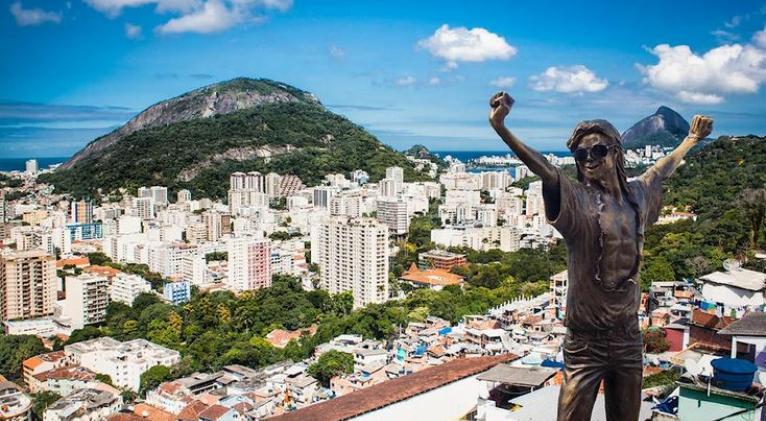
In 2008, it became the first community in Rio to receive a Pacifying Police Unit (UPP). Even today, more than 3,000 visitors a month walk its streets and pose next to the bronze statue of the singer, erected in his honor at the exact spot where he filmed the video.
Police Violence and Structural Racism: The Enduring Relevance of the Message
Marcinho VP, however, did not have a storybook ending. In 2003, he was found dead in the maximum-security prison Bangu 3, allegedly suffocated by his cellmates. His story—raw and tragic—was narrated in the book Abusado by Caco Barcellos, which revealed the complex web of power and violence in Rio's favelas.
Nearly three decades later, They Don't Care About Us has surpassed 1.2 billion views on YouTube and remains an uncomfortable and necessary reminder: even in the midst of spectacle, Michael Jackson chose not to look away. He took his art to the epicenter of pain and transformed it into dance, rhythm, and denunciation.
Because, as the song said, "all I wanna say is that they don't really care about us." And yet, with his music, he demonstrated that he did.
A Message Reborn Amidst Renewed Violence
The story of the They Don't Care About Us music video is regaining strength in a context painfully similar to the one Michael Jackson denounced almost three decades ago.
Comando Vermelho and the Deadliest Police Operation in Rio de Janeiro
Just a few days ago, Rio de Janeiro was the scene of the deadliest police operation in its history: a large-scale operation against the Comando Vermelho criminal group, which left 132 dead and 81 detained in the Alemão and Penha complexes.
Images of bodies in the streets, reports of extrajudicial killings, and testimonies from terrified residents have reopened the debate on state violence, the militarization of favelas, and structural racism in Brazil.
In this climate of indignation and pain, Jackson's song—conceived precisely as a denunciation of police brutality and institutional indifference—has been reclaimed by social movements and users on social networks as a symbol of resistance.
Thus, the message of They Don't Care About Us, filmed between the poverty and pride of Santa Marta, resonates powerfully once again in a country still struggling to break the cycle of exclusion and violence that the "King of Pop" himself sought to expose in 1996.






Add new comment