
 English
 Español
Cuba Commemorates Five Decades of Collaboration with Russian Institute
especiales
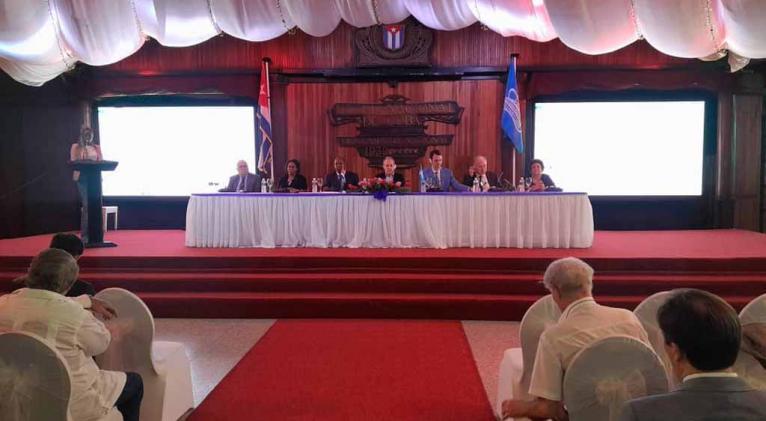
Cuba today commemorated the 50th anniversary of cooperation with the Joint Institute for Nuclear Research (JINR) in Dubna, Russia, an exchange that facilitates studies to combat diseases using nuclear medicine, among other projects.
The ceremony, held at the Hotel Nacional in the capital, was attended by guests from both countries and headed by Cuban Minister of Science, Technology, and the Environment, Armando Rodríguez. Cuba's Plenipotentiary Representative to JINR, Gonzalo Walwyn, recalled the beginnings of Cuba's incorporation into the institute on March 26, 1976.
Since then, more than 300 Cubans have participated in advanced science and technology programs, with others trained in fields of theoretical and experimental physics, radiochemistry, nanotechnology, and computer sciences.
He also enumerated some of the principal research initiatives and projects, such as the characterization of nanomaterials, radio-sensitivity studies in tumors, and the use of biophysical models against brain diseases.
These are joined by projects for membrane production, radiation detectors, and diagnostic systems used in nuclear medicine.
During the commemoration, JINR Director Grigory Trubnikov delivered a keynote lecture on the history and future projections of the institution.
The Joint Institute for Nuclear Research in Dubna is an intergovernmental scientific organization known worldwide for its outstanding contribution to the fundamental fields of physics.
The institute has established cooperation with around one thousand research centers and universities and annually organizes more than 40 international conferences and meetings. JINR publishes approximately 1,500 scientific articles and reports each year.
Among its member countries, in addition to Cuba, are Armenia, Azerbaijan, Belarus, Bulgaria, Egypt, Georgia, Kazakhstan, the Democratic People's Republic of Korea, Mongolia, Romania, Slovakia, Uzbekistan, and Vietnam.
A video compiling the main stages of the collaboration, with testimonies from researchers and exchanges with founders, was part of the commemoration.







Add new comment