
Trump Administration Dismisses Crisis Fears Following Series of Tech Outages
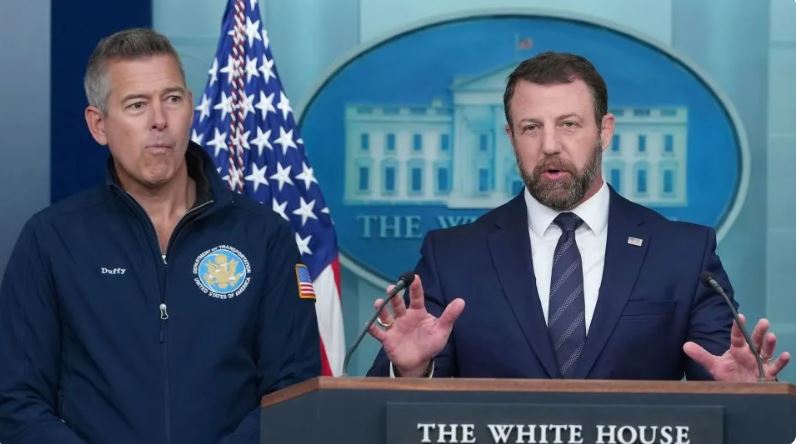
El secretario de Transporte de EE.UU., Sean Duffy (izquierda), y el secretario de Seguridad Nacional, Markwayne Mullin (derecha), hablan durante una conferencia de prensa en la Casa Blanca, el 13 de noviembre de 2026. - Alex Brandon/AP
Senior officials in Donald Trump's administration sought to reassure Americans and dispel fears of a potential crisis after a series of major technology and infrastructure failures disrupted travel, business, and banking operations for millions of people.
"We don't see a crisis coming. But you have to be prepared for everything," U.S. Vice President J. D. Vance told Fox News in an interview published Monday.
Vance noted that some friends had asked him whether they should build bunkers or stockpile food and water. "My answer to that is no," he said, adding that news reports about Pentagon bases preparing to operate off the electrical grid for 90 days—as well as similar reports of European countries urging citizens to stock up on supplies—are simply measures of "basic good governance."
"It's about ensuring that our armed forces are prepared, God forbid, in the event of a crisis," Vance said, "but we don't see a crisis coming."
Vance's remarks follow a chaotic week marked by technological disruptions and confusion.
Last Thursday, a massive outage of Microsoft services left users worldwide without access to Outlook email, Teams meeting tools, and other staples of modern office life. Microsoft attributed the issue to a technical glitch that took roughly two days to resolve and, according to some estimates, may have cost $7 billion in lost productivity.
That incident had not yet been fully resolved when, on Friday, the Federal Aviation Administration (FAA) suffered a system failure that triggered thousands of flight cancellations, generated chaos at airports, and left millions of travelers stranded just ahead of the weekend. The FAA suspects the crisis was caused by a single newly installed router at a remote radio station in Arkansas.
Subsequently, on Monday, major banks reported problems.
Thousands of Chase Bank customers experienced difficulties using their online accounts and completing transactions at physical branches; the company attributed the incident to a software bug. Issues were also reported at other major banks, including Bank of America, Wells Fargo, and U.S. Bank—though on a smaller scale—which appeared to be linked to sending money via Zelle (a digital payment network) to Chase accounts.
Later on Monday afternoon, United Airlines reported a widespread yet brief outage of its systems, delaying some flight departures. The glitch lasted about 30 minutes and affected fewer than 150 flights, an airline spokesperson told CNN.
There is no evidence suggesting these issues were directly connected to one another, as Homeland Security Secretary Markwayne Mullin emphasized in a separate interview with Fox News on Monday night.
"I can tell you with 98 percent certainty that we are not seeing any cyberattack: no one has claimed responsibility, we don't see unusual traffic or traces of intrusion or data exfiltration; therefore, nothing indicates there is a connection between the incidents," he stated.
He added that the government's cybersecurity agency had briefed him that the various service disruptions "were unrelated to each other."
Like Vance, Mullin sought to calm public unease, telling Americans, "Relax. The country is safe." He noted that authorities had managed to respond to each crisis and restore services quickly.
"We are simply inundated with technology, and our modern world runs on it. Previously we had backup systems, but now those systems are overwhelmed by new technologies," he added.
Some experts agree, warning that this technological overload is actually the common factor linking last week's failures.
"I think there is a connection in the sense that much of our infrastructure, both in this country and around the world, is aging," said Alex Hamerstone, a cybersecurity expert at the consulting firm TrustedSec.
"It is constantly evolving and changing, and our reliance on these technical systems grows day by day… Everything is becoming increasingly interconnected technically and more complex."
Vance acknowledged this in his Fox News interview, noting that the administration had invested in rebuilding and replacing aging infrastructure, though a broader overhaul would require additional funding approved by Congress.
"The problem is that we are dealing with 50-year-old technology. It works most of the time," he said. "Sometimes you have to rely on a patchwork of temporary fixes to keep a 50-year-old system running. Why do we have a 50-year-old system in the first place?"
Transportation Secretary Sean Duffy requested up to $50 billion in emergency funding this weekend following the FAA's ground stop order; however, key Republicans, including current Senate Majority Leader John Thune, are demanding more information about the request, as well as details on how the administration utilized previous funds.
Last year, Congress approved $12.5 billion to modernize air traffic control systems—an allocation that many lawmakers, including Thune, have argued has not yet been fully spent.
Add new comment