
The Paraguayan "Paradigm"
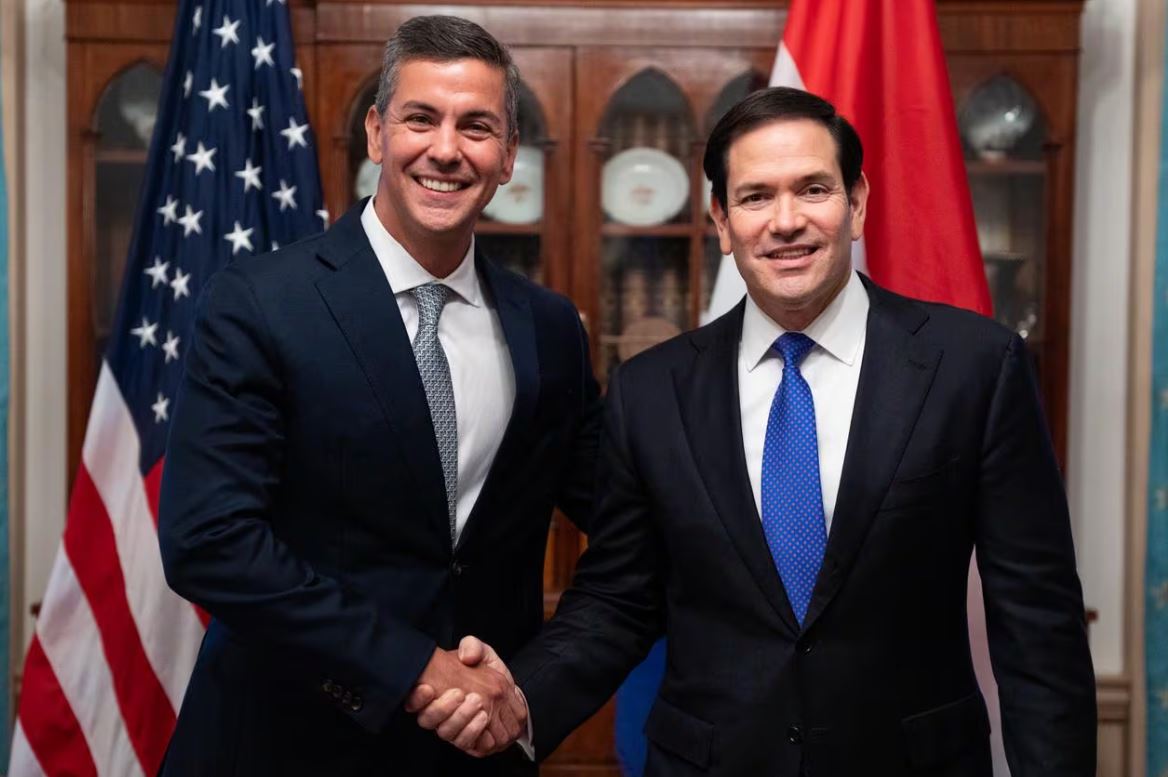
El expresidente de Paraguay, Santiago Peña, junto a al Secretario de estado de EEUU, Marco Rubio
Paraguay is a remarkable country, both for its privileged natural resources—especially its water reserves, which in a few years will be more coveted than oil—and for its people and Guaraní traditions, curiously preserved against all odds.
It spans roughly 406,752 square kilometers, bordering Argentina, Uruguay, and Brazil. That very geographical circumstance meant that between 1864 and 1870, it was subjected to a cruel aggression known as the War of the Triple Alliance, when neighboring countries invaded because, unlike its neighbors, as early as the second half of the 19th century, a form of industrialization had begun to emerge in Paraguay in pursuit of economic autonomy—something unacceptable to the empire of the era, Great Britain, and to the neighboring agro-exporting oligarchies subordinate to it. This virtual genocide left an indelible mark on the Paraguayan identity, erupting from time to time like volcanic magma.
Following the long dictatorship of Alfredo Stroessner (1954–1989), "democracy" was finally installed in the country, with governments generally succeeding one another from the Colorado Party—Stroessner's party—with the notable exception of the brief government of the leftist priest Fernando Lugo, which was cut short through procedural maneuvers in classic South American style. The Colorados have featured figures notorious for corruption—bandits in the broadest universal sense of the term—such as former President Horacio Cartes, currently the behind-the-scenes power broker in the country, since, needless to say, it is still the Colorados who govern.
This brief history serves to better understand the political crisis unleashed on November 6 in the country, centered on the outgoing former president (now imprisoned), Santiago Peña, who was virtually ousted by enraged masses when they were suddenly hit with what in Argentina is called "the corralito"—literally, no one can withdraw their money from the bank simply because it is no longer there. This is the widely publicized collapse of Ueno Bank. What happened?
One fateful day, 2.9 million customers of Ueno Bank, without prior warning or predictable signs of what was coming, learned that the institution was insolvent, meaning all their savings and personal funds had vanished as if by magic. Among the accounts turned into cosmic dust were pension funds valued at no less than $500 million, out of a total "missing" sum close to $2.8 billion, according to unofficial figures (official ones have not been released).
The Ueno Bank conglomerate also participated in other sectors of the economy and counted among its best-known executives the man who would later become president of Paraguay, Santiago Peña. Up until the debacle, Ueno Bank was presented as the most dynamic in the country, hailed for excellence due to its "transparent" digital transfer practices.
Amid this confusion, it also came to light that investment funds marketed by Ueno Bank had "collapsed," now classified as "junk bonds," affecting investors from the United States and elsewhere. Even the FBI and JPMorgan have stepped into the fray to investigate what happened.
This is not the first time in recent years that a major private bank like Ueno Bank has collapsed in South America, yet what matters here is the context in which this genuine socioeconomic catastrophe takes place, particularly regarding those involved.
The aforementioned downfall of President Santiago Peña appears to validate those warning that the much-vaunted wave of far-right victories in the region—characterized by unlimited subordination to the Empire under Trumpist leadership and Zionist omnipresence—has begun to unravel.
More specifically, the current political crisis in Paraguay demonstrates clearly for the first time that the causes of this decline among the far right are not limited solely to electoral defeats or backlash against deeply unpopular economic policies.
Strictly speaking, events in Paraguay plainly reveal that another fundamental problem lies in the ethical caliber of the leaders of these Trump-aligned projects. That is, as has been warned so many times, if anything unifies all far-right leaders in the region—and arguably the world—it is the corruption they practice while in office, and in some cases, the track records they bring with them. Consider Trump, widely characterized by critics as the most corrupt president in U.S. history.
Examples abound, and virtually the most prominent figures of this faction (the far right) have behaved true to form during their terms: there are the cases of Milei, whose corrupt economic policy favoring a select few explains why Argentina was ranked by the World Bank as one of the three poorest countries in the Americas, dropping 10 spots in that index. Much has also been said about Noboa, the Ecuadorian leader linked to drug trafficking allegations. Nor should one forget the notorious Honduran president, Nasry Asfura, who faces an ongoing case involving a scheme to embezzle and launder public funds (in 2017–2018) during his tenure as mayor of Tegucigalpa—a matter with prior documented references as well.
Returning to Peña, in case it is not widely known, the former Paraguayan president was repeatedly held up as a role model—a paradigm of how to govern a country efficiently, particularly in economic policy, as well as how the relationship between the state and the private sector should operate within the ever-labyrinthine world of finance.
Part of the corruption scheme implemented in Asunción is the so-called "revolving door," which exists in other countries across the region. For example, Carlos Carvallo, formerly a senior executive at Ueno Bank, went on to head the Central Bank of Paraguay (BCP), the entity responsible for overseeing bank operations, including the now-bankrupt Ueno Bank. In other words, at one moment this individual manages a private enterprise, and at the next, he heads the state agency tasked with auditing the ethical conduct of that very enterprise. Peña, of course, was the one who appointed Carvallo to lead the BCP.
Precisely the avenues opened by this mode of operation, such as the "revolving door," also explain the transfer of public funds—belonging to all Paraguayans, and especially pension funds—to be managed by Ueno Bank. The original idea stems from the notorious privatization processes used to capitalize pension funds, an ultra-neoliberal practice popularized by none other than the criminal Pinochet, one of the idols of the current Chilean president, another far-right figure; as one can see, the far right has its traditions too.
Incidentally, something smells suspicious in Honduras regarding this policy of converting retirees' resources into private bank shares without even consulting them. It turns out Asfura is also seeking to "capitalize" public employees' pension funds into a private bank, Ficohsa, to the tune of about $36 million. Everyone hopes it does not suffer the same fate as Ueno Bank.
In this saga, the sinister figure of Fernando Cerimedo—the convicted femicide inmate locked in a maximum-security prison in Bolivia—resurfaces once again. The macro media-manipulation apparatus built by this individual poses an extraordinary obstacle to the timely exposure of the felonies described here, which harm millions of people, such as the Paraguayans defrauded today.
Aware of this, financial schemes like Ueno Bank participate in operations to fund regional far-right activities, acting as cashiers for these political structures. Amid the ongoing investigations, such ties have come to light, notably involving Trump and his inner circle—including his sons—and, of course, Marco Antonio Rubio García, architect of U.S. foreign policy.
For instance, the case of the Hispanic Prosperity Gala, held in February 2026 at Mar-a-Lago—the U.S. president's private residence converted into a White House protocol venue for the dividends it yields Trump—was exposed. Money from Ueno Bank—or more accurately, perhaps from Paraguayan retirees—was present there. At the event, Cerimedo was honored, alongside one Andy Rivas, Peña's own "Cerimedo," and inevitably Pascale, the "Cerimedo" of Trumpism and Zionism. Joining via video call were the president of Bolivia and someone who never misses these gatherings, Milei.
Every day, further perverse purposes served by Ueno Bank are publicized; the conveniently hidden hand of Zionism—experts in absolute opacity—emerges. Investigations indicate that Ueno compiled an extensive database of all its clients using Israeli software, which naturally resides in the digitized files of Mossad (the Israeli intelligence service). It is further noted that there was a project underway to fine-tune that software for broader deployment elsewhere.
In a way, all the pieces fit together; the peculiar relationship between Peña's government and Israel seemed somewhat suspicious, even more unrestrained than that displayed by his neighbor Milei. There is little need to explain Zionist appetites for sparsely populated territories rich in resources, such as those found in the Argentine Pampas or Paraguay's western Chaco. Does the Ueno Bank debacle represent a blow to certain expansionist plans, or, as some experts suggest, a long-term concept to "colonize" other territories beyond West Asia with Israelis? Time will tell.
The ties of the imprisoned former president Peña to the corrupt politicians of South Florida are also coming to light; one must admit these figures are consistent in their eagerness to align with the worst elements in the hemisphere. Photos are surfacing these days showing Peña with anti-Cuban lawmakers of Cuban origin, Díaz-Balart and Salazar—figures who will one day have to answer for the countless images showing them alongside Latin American political corruption. As noted before, wherever these phenomena appear, Trumpism is present in some form, and since this is Latin America, Rubio García and company are involved.
On October 17, an article titled "Onward! For We Are Winning" was published here, emphasizing the bankrupt nature of far-right leadership. Now the next head is already poised to potentially roll, once again thanks to Cerimedo, who in one of his recently surfaced audio recordings admits to collaborating on an electoral data-manipulation project that may explain why Keiko Fujimori was ultimately declared president of Peru by a narrow margin once votes from the U.S. and Argentina were tallied—quite a coincidence, isn't it? Similar rumors are also beginning to swirl around Chilean President José Antonio Kast.
So get comfortable, because you will soon witness another Desert Storm across the plains of the prominent members of the Shield of the Americas—a pale imitation of the so-called Lima Group, established in 2017 to encircle Chavista Venezuela, which dissolved in its own acid when the Peruvian president who founded it, Pedro Pablo Kuczynski, was relegated to the dustbin of political irrelevance.
To reiterate: "Onward! For we are winning"—anyone who doubts it does so by choice. And those responsible in these countries for accelerating the removal of these far-right elements—preachers of the worst, dry-palated and utterly shameless—must expedite whatever actions are necessary; they know what to do, for the people cannot wait.
Translated by Sergio A. Paneque Díaz / CubaSí Translation Staff
Add new comment