
Geopolitics: Iran, a Tipping Point?
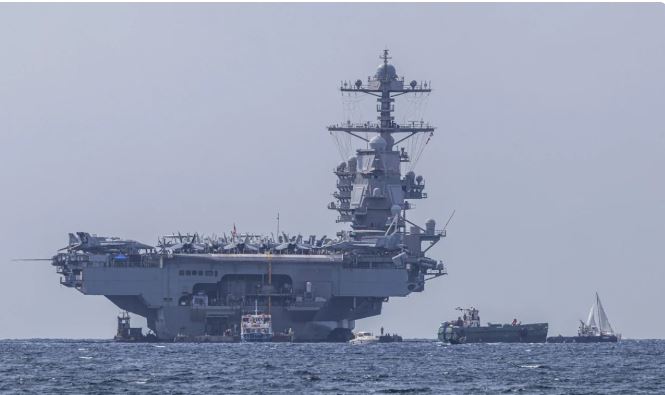
EE.UU. enviará a su mayor portaaviones, el USS Gerald R. Ford, desde aguas del Caribe
Is Iran the Serbia or Belgium of a new global war? Are we facing a new 1914 or 1915 in 2026?
The Iranian crisis has taken another chapter with the concentration of Western forces in the Persian Gulf and the possibility of a regional confrontation with global escalation. The positioning of the powers in that part of the world has been a chess game in which pressures are carried out millimeter by millimeter and controlled in such a way that the adversary's reach is measured and red lines are established. Precisely, the support of China and Russia for Iran has been crucial in sustaining the balance in the Middle East in the face of Western positioning in favor of Israel. The United States has used Tel Aviv as an elementary enclave in hegemonic aggressiveness, so the permanence of the Zionist regime is a matter of existential priority for the American elite. It is about oil and power, not about democracy or elections, not about authoritarian or liberal regimes. That is the pragmatism with which the panorama of a portion of the world that has been inflamed in conflicts for some time, under the pressure of the powers that parasitize it, should be unveiled.
Extractive or vulture capitalism, which has lorded it over fossil fuels, has calculated how much time remains for that model, and to the extent that it becomes unsustainable, wars for control increase. In geopolitics, this is evidenced by the moves the United States has made in recent times toward areas that constitute natural reserves of that fossil. If Iran possesses oil, it also controls an important part of the commerce of said product through its strait, so the closure of routes directly affects price stability and inflation within Western countries. As we know that the United States is in an election year, anything is possible in terms of conflicts in order to lower the price of gasoline and convince the American middle class that Trump is the leader that suits them and that MAGAism will save the nation. The move is based on military superiority, but it is known that it is not absolute, that it is contained, that total hegemony can no longer be assured as in the first and second Gulf Wars. The asymmetry of the use of drones and hypersonic missiles has made aircraft carriers the weakness of the U.S. Navy. What was once a strategic advantage could now become a disaster. And that, both militarily and psychologically in political matters, is a blow for which Trump has no weapons to respond or recover from the fall. Therefore, it is not so simple.
Iran has always been in the focus of Western powers. Under British hegemony for centuries, due to the Empire's power in the region; it passed to U.S. control after World War II. The Shah of Iran was a figure who dialogued and reached agreements with Westerners and served as a conservative pivot against forces sympathetic to liberation movements in the Middle East region. However, intelligence reports have revealed that both British and American services always kept this figure of the Iranian monarchy under surveillance and distrust. The interest in oil determined relations and established the limits of loyalties. Finally, with the Iranian Revolution, the fall of the Shah gave way to a process of transformations in the political, social, religious, and cultural order that posed an incompatibility with Western projects in the region and basically with Zionism. Tehran went from being a capital aligned with the West to playing a key role in the counterbalance and in the multipolar world.
Currently, after the fall of U.S. control in Afghanistan and India's movement toward the BRICS group, Asia and the Middle East are becoming a region where multipolarity is felt more strongly. That means that, in terms of resources, it is no longer the Westerners who decide markets, prices, and alliances. Even countries traditionally aligned with the United States, such as Qatar and Saudi Arabia, have established ties with the emerging economic pole, and that signifies a danger to the power of the petrodollar. What this latter means is that to the extent that oil trade occurs in other currencies and foreign exchange reserves are established based on those transactions, the dollar system becomes obsolete and its value declines in the flow of global trade. That is precisely the project of the BRICS group: to question the power of the U.S. currency by establishing a financial system with greater incentives and creating a pull effect toward investors, global companies, and countries.
Under Trump's mandate, the BRICS have continued to grow, and the movements of their power project are sustained. In the case of Iran, it is a point of regional pressure due to the weight of oil in the creation of foreign exchange reserves for countries adversarial to the United States. That is exactly what was happening in Venezuela, and we already know the result. The move is based on issues of survival of Western power and its geopolitical permanence. Believing that it is about ideological questions or matters concerning human rights is to go off on variables that are not actually on the table of decisions at the powers' meetings. Now then, is this gunboat diplomacy totally effective?
Let us recall that among the main goals that commerce requires to grow and accumulate capital is global stability. Everything that was done after World War II with the creation of the United Nations system and international treaties had as its starting point the great slaughter and disaster of a world in which there was no law and things were simply imposed as happened between 1939 and 1945. However, beyond the historical cause, what International Law pursues and why it was an interest for Western elites is stability. Predictability of the conflict system had to be achieved so that it would not damage or break supply routes and the possibility that stock market values would abruptly decline, taking away the fortune of large companies and firms. For this, the UN system was the political face, to dialogue and resolve issues as much as possible and sustain business. With wars, trade falls and capital stops flowing. Furthermore, when you possess advantage as a nation and you are the hegemon, you establish the Pax Americana, as great empires have always done; it is the peace of the powerful, of the one who has won the war and puts an end to war to govern. All of that has already been broken. The questioning of that Pax Americana and the real possibility of its end is what has led the United States to react again with interventionism. Therefore, what seems like a show of force is one of weakness.
Let us return to Iran. The recent protests—which may perhaps have some level of reason at the level of that country's own internal conflicts—have been co-opted by the West to pivot them toward their interests. It is the same script of soft coup that has been seen in other regions and at so many moments. The bet is to bring down a member of the multipolar group that does not yet possess atomic weapons and whose response therefore remains contained in the region. But playing with war can ignite other wars. In 1914, Austria-Hungary sent an ultimatum to a small nation that apparently could not defend itself, Serbia. The conflict was planned for a short duration and could be resolved locally in terms of Balkan geopolitics. However, we already know that led to World War I based on the system of global alliances and counterbalances. And this is precisely a scenario that internally possesses the same variables. Making peace through war, as the ancient Romans thought in their moment of maximum power, was feasible if you know that your enemy is not cohesive and powerful enough to respond and put you out of commission. Because if the latter happens, the consequences spiral out of control.
History does not repeat itself exactly, but the clash of geopolitical interests when there is no efficient international diplomatic negotiation system is a powder keg. There will be agreement if the parties see that the sum of the slaughter equals zero, but as long as the United States understands that it can pressure without major existential consequences, it will do so. The pattern with Donald Trump is this: he takes the conflict to an unsustainable tipping point and then offers agreement conditions totally advantageous to the American portion. But the rope that is being stretched has its limits, and the policy of pressure and force can and is in fact wearing down the empire's power. Nations that were allies have seen that they can no longer trust, and NATO is breaking apart. With the end of the Westernist international system, countries are leaving the post-World War II orbit and have sought other, more advantageous alliances. It is only a matter of time before all this becomes a boomerang for the United States. Trump governs to achieve an effect of power in the now, but his decisions are compromising the smart power and cohesion of the Collective West for the next hundred years.
Political scientist and professor Jeffrey Sachs has said it consistently on his YouTube channel: we are facing a collapse of the Pax Americana, and that blow comes from within, from bad decisions and the unhealthy alternation that nullifies international coherence of U.S. power. The export of debt through the dollar and its use to penalize and persecute global adversaries are edges that are building the coffin of the United States in this century. And its real hegemony, if it ends, would not have reached a century intact from 1945 to 2045. Iran could be the tipping point. It is far from the center of military power in America, it has alliances with highly armed irregular groups in its region, it possesses real-time intelligence reports, and also a geopolitical counterbalance with great powers. The game is not the same, and the United States can lose a lot. History has shown that wars against weaker states can create terrible upheavals in more powerful aggressor states. Look at the example of Vietnam and the Americans themselves in the 20th century. Perhaps intelligence and geopolitical advisors are in this case making a miscalculation with apocalyptic proportions.
The BRICS, meanwhile, have continued to offer advantageous trading conditions. Many of the world's resources, especially rare minerals, are being calculated in yuan reserves, which already represents a challenge to Western hegemonism. The United States has opted for creating proxy wars against great adversaries and direct wars against adversaries of lesser military weight. It is Napoleon's old tactic of confronting a great enemy by dividing it into parts. Along the way, Trumpism has broken the very alliances that protected the United States and has launched Europe into a free fall toward the hands of Russia in energy and China in trade. In terms of security, we already see that NATO is in an almost dissolution phase.
The new world that the crisis is birthing does not offer the same advantages to Americans as in the past. The British Empire had exactly a century of uncontested hegemony: from the Battle of Waterloo in 1815 to the start of World War I and London's entry into the conflict in 1915. And let us recall why such intervention occurred: the German invasion of Belgium broke the balance of the great powers in the geopolitical game. Once again, conflict in a small nation gave way to greater ruptures that redefined history. But if something sustained the English at the top, besides their naval power and commerce, it was the ability to achieve, whether by force, blackmail, coercion, or the offer of advantages, a system of Anglo-Saxon alliances from which even the United States benefited during its imperialist ascent in the late 19th century. This tells us that an empire is not sustained with gunboats alone, and even that wars are not convenient for those great powers that require stability and the predictable character of international relations to build their decision-making dome.
Is Iran the Serbia or Belgium of a new global war? Are we facing a new 1914 or 1915 in 2026? History does not repeat itself exactly, but the field of human conflicts could yield us matrices of analysis that help us in the concretion of lines of meaning.
Translated by Sergio A. Paneque Díaz / CubaSí Translation Staff
Add new comment