
New Regulations Strengthen Cuba’s Pension System
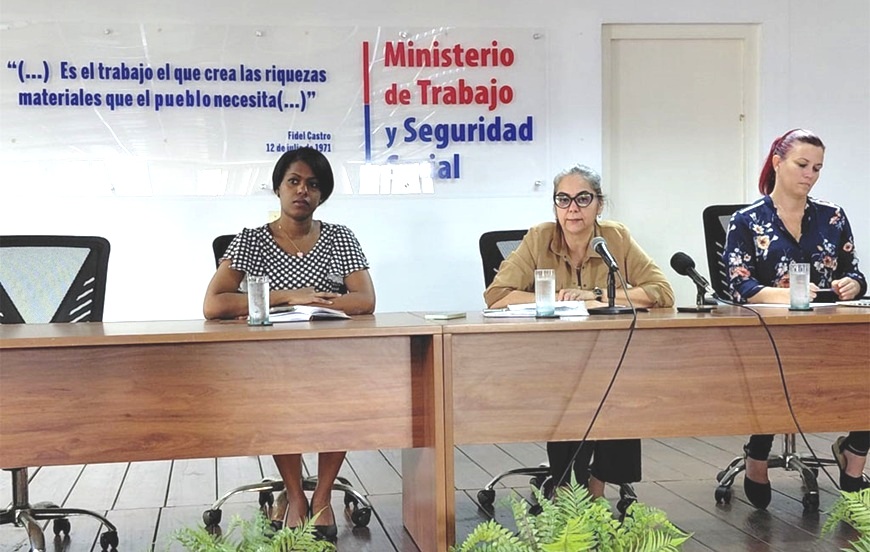
Foto: tomada de PL
Cuba now has new legal provisions that update the financing and protection mechanisms of the social security pension system, with the aim of expanding the guarantees and rights of its beneficiaries.
Published Wednesday in the Official Gazette of the Republic, Decree-Laws 140 and 186 amend existing regulations to align them with the country’s economic and social transformations and its demographic and labor dynamics, which are characterized by an aging population, a rise in self-employment, multiple-job holding, and the recognition of care work.
Adelaida Puentes, director general of Social Security at the Ministry of Labor and Social Security (MTSS), told a press conference that among the main new features is the elimination of the cap on the scale established for social security contributions paid by non-state sector workers and those covered by special regimes.
She explained that the scale must be updated in the last quarter of each year and may be modified annually, except during the five years prior to reaching the age required to qualify for an age-based pension.
The official specified that, in addition to eliminating the maximum cap, a minimum contribution base is established that is higher than the country’s current minimum wage, which is presently set at 3,210 Cuban pesos.
The regulation also stipulates that employees engaged in multiple jobs must enroll in the general regime or in the special regimes corresponding to each of the activities they perform. In this way, those who hold more than one job will be able to contribute for both, which will have a favorable effect on the calculation of their future pensions.
It was clarified, however, that in cases of simultaneous employment, only the amounts contributed toward retirement will be accumulated, not the periods of time worked.
Another new provision establishes that, of the 30-year minimum of service required to obtain a pension, up to 10 years spent caring for dependent family members may be recognized.
The legislation also incorporates a benefit for young people between the ages of 18 and 30 who are out of school and out of work and who enroll in training courses. In such cases, they will receive a monthly income equivalent to the minimum wage, and the training period will be recognized as time of service.
For her part, MTSS legal director Yiseilis Ferrer noted that these decrees complement provisions already in force, such as the Families Code and the regulations governing the National System for Comprehensive Care Throughout Life.
Añadir nuevo comentario