
Fidel in the Olympus of Chess 60 Years Ago
Fidel en el Olimpo del Ajedrez 60 años atrás
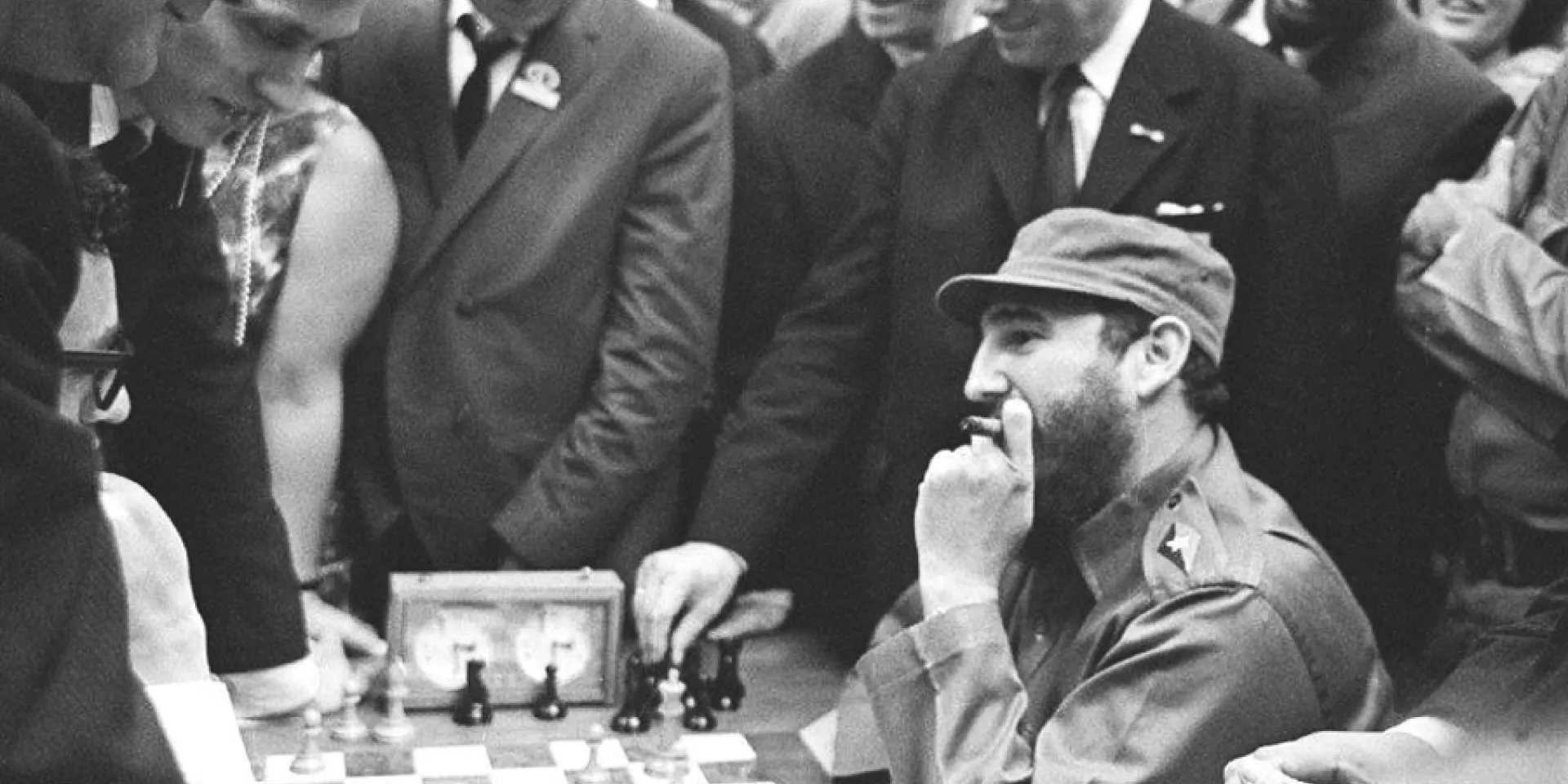
The principal stars of the “game-science” of the era, gathered on the rosters of 52 teams, took part in the event, which enjoyed the customary attendance of the Commander in Chief, Fidel Castro Ruz, who chaired the Honorary Committee.
Fidel played the first and the last game of the second such event held in Latin America, after the one hosted by Buenos Aires, Argentina, in 1939, which marked Cuba’s debut under the leadership of José Raúl Capablanca.
After the opening ceremony on October 25, 1966, the leader of the Revolution made an appearance at the Habana Libre Hotel, mingled with several players, and met Mexico’s Filiberto Terrazas, who was accompanied by José Luis Barreras, general director of the Olympiad, who handled the introductions.
The Cuban head of state and the player from the land of the Aztecs chatted about the development of chess in Mexico, and at one point in the conversation Fidel invited him to play a game.
They sat down at one of the tables and began a game that unexpectedly turned into a consultation game: Fidel Castro and Tigran Petrosian moved the white pieces, and Filiberto Terrazas and Robert Fischer the black.
Licenciado Terrazas, who died on February 12, 2022, noted in a testimony for the Cuban magazine Jaque Mate:
“Our opponents get a passed pawn on the king’s flank and push it until Fischer and I decide to resign. No sooner had we shaken hands than Fidel quickly sets up the pieces again and says to me: ‘Now you and I are going to play alone.’”
Terrazas, then 20 years old, later stated regarding his second game with Fidel that the Cuban leader had offered him a draw, but he declined, and so when he won he joked: “This gentleman let himself lose.”
The Olympiad held in Cuba was dominated by the Soviet Union, the undisputed queen of the checkered board in those days.
The winners fielded Tigran Petrosian, the reigning world champion; Mikhail Tal, known as the “Wizard of Riga,” who had already ruled the discipline worldwide; and Boris Spassky, who was about to ascend the throne in 1969.
The roster of the squad that claimed the Hamilton-Russell Cup for the eighth time was rounded out by fellow grandmasters Leonid Stein; Viktor Korchnoi, a two-time world runner-up who later settled in Switzerland; and Lev Polugaevsky, a regular participant in the matches contesting the crown.
The United States, with Robert Fischer, the chess master who broke the Soviets’ hegemony in 1972, took second place, while Hungary, with the renowned Lajos Portisch on first board, finished in the third spot.
Next came the former Yugoslavia, with Svetozar Gligoric and Borislav Ivkov on the two top boards, while Argentina, with Miguel Najdorf on first board, was the most outstanding Latin American nation, finishing in fifth place.
For its part, Cuba secured fourteenth place with a team made up of Eleazar Jiménez, Rogelio Ortega, Edis Cobo, Jesús Rodríguez, Silvino García, and Hugo Santa Cruz.
Placed in Group VI, which was won by Hungary, the Cubans managed to reach the final stage thanks to a dramatic victory by Rogelio Ortega over Josef Boey in the match against Belgium, after 66 moves.
On Saturday, November 19, the day marking the 78th anniversary of the birth of José Raúl Capablanca, the final round of the World Chess Olympiad was played in the Ambassadors’ Hall of the Habana Libre Hotel.
At 9:00 a.m., a giant simultaneous exhibition with 6,840 boards, the largest held in the world up to that time, took place in the Plaza de la Revolución.
At around 11:00 p.m., a huge downpour caused some of the remaining players to abandon the simultaneous exhibition.
The Commander in Chief faced the then world champion, the Soviet Tigran Petrosian, in the presidential row. The game ended in a draw, as the Armenian courteously offered a draw, which Fidel accepted.
According to Ciro Pérez’s account in Bohemia magazine, Petrosian began his games quickly, and upon reaching Fidel, told him that against him he had to think through the opening.
The world champion played 1.e4, and Fidel likewise answered with 1...e5. Later in the game, the ninth king of the checkered board, after steering the play, offered the Cuban leader a draw, and Fidel, smiling, said:
“There is no doubt that Petrosian, besides being a great champion, is a diplomat.”
Eddy Martín, the prestigious sports broadcaster, writing about the leader of the Revolution’s meeting with the chess players and the press following the closing ceremony on November 20, published the following words from the leader a day later in the newspaper Juventud Rebelde:
“From this Olympiad we are going to reap very good results, since enthusiasm has grown enormously. We will have to make thousands of boards and sets because demand is going to increase considerably. I don’t know, perhaps we will have to make them out of plastic or some other material.”
Añadir nuevo comentario