
Díaz-Canel Closes CE-GESTA 2026
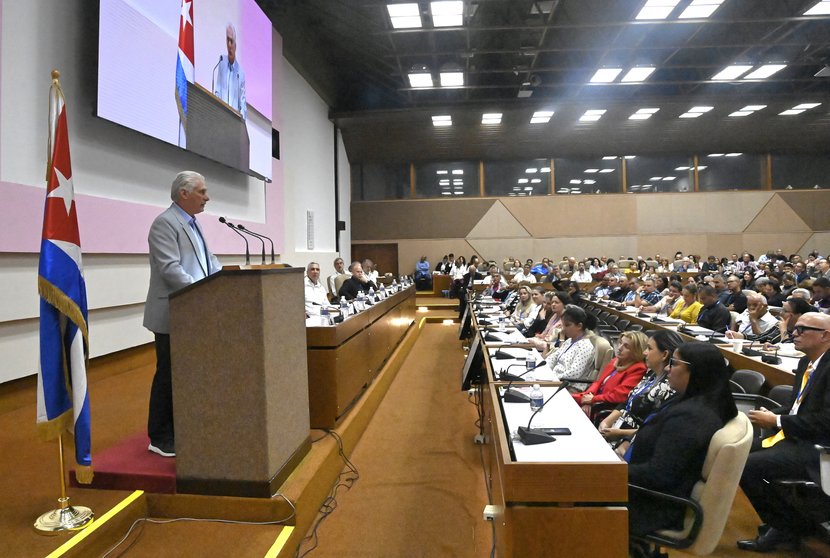
El Primer Secretario del Comité Central del Partido Comunista de Cuba y Presidente de la República, Miguel Díaz-Canel Bermúdez, participó este jueves en la clausura del Congreso Internacional de Dirección, Desarrollo Local, Turismo y Cooperativismo (CE-GESTA 2026), celebrado en el Palacio de Convenciones de La Habana, acto en el que recibió un reconocimiento especial por su condición de fundador y principal impulsor de la Red Universitaria de Gestión del Conocimiento y la Innovación para el Desarrollo Local (GUCID).
The First Secretary of the Central Committee of the Communist Party of Cuba and President of the Republic, Miguel Díaz-Canel Bermúdez, participated this Thursday in the closing ceremony of the International Congress on Management, Local Development, Tourism, and Cooperativism (CE-GESTA 2026). Held at the Havana Convention Center, the event featured a special recognition awarded to him as the founder and primary promoter of the University Network for Knowledge Management and Innovation for Local Development (GUCID).
Representatives from the Ministry of Higher Education and the "Hermanos Saíz Montes de Oca" University of Pinar del Río, the event's organizing institution, highlighted the president's transcendental contribution as the founder and main driving force behind the GUCID Network, as well as his efforts to position local development on the public agenda across all levels of government. Their citation also noted that Díaz-Canel Bermúdez was serving as Minister of Higher Education when the network was created, praising his "commitment, vision, and unconditional support" in strengthening ties among academia, government, and society to foster territorial transformation across the country.
In his closing remarks, the head of state addressed the significance of the GUCID Network's two decades of existence, stating that its impact is not measured solely by workshops held, publications edited, or diploma courses taught, but rather by what the network has demonstrated through concrete results.
First, he noted that the university-territory link is achievable when institutional will and shared methodologies are in place. The network connects dozens of universities alongside a core system of municipal university centers covering practically the entire nation, he explained.
Second, he added that managing knowledge means connecting those who produce it with those who need it to solve economic and social challenges. Within the context of ongoing transformations—ranging from the banking and exchange rate systems to tourism and the productive sector—this connective function is essential.
Third, the president stated that building local capacities is irreplaceable; without local managers trained in administration, project management, and innovation, development strategies remain incomplete. Higher technician programs, territorial diploma courses, and training initiatives must multiply and adapt to the realities of each municipality, he pointed out.
Fourth, he emphasized that research using tools of resilience is a tangible reality. Amid a blockade and an energy siege, the network has proven that applied science, collective intelligence, and endogenous resources form the foundation that keeps research moving forward. "Every classroom, every diploma course, every workshop is an act of cognitive sovereignty," he expressed.
Speaking at the conclusion of the congress, which began on Tuesday, November 11, the Cuban leader stated that its central thesis was "the transformation of management as a condition for economic and social transformation," calling on participants to "move from researching management to transforming management."
To achieve this, he explained that enterprise autonomy "only makes sense if the director is a leader of the change process rather than a passive executor," resting effective management on three pillars: "autonomy with responsibility, a sense of belonging, and social responsibility as a constitutive part of the mandate, because an enterprise is not merely an economic unit—it is, above all, a social unit."
The head of state insisted that local development "is not decreed, it is built," underscoring that it must be constructed "municipality by municipality, cooperative by cooperative, enterprise by enterprise, territory by territory."
Likewise, he pointed out that with the 176 economic and social transformations, the country possesses for the first time a regulatory framework recognizing the municipality as the protagonist of development, setting the challenge for the next decade to "turn every municipality into a laboratory for territorial innovation."
Regarding this ongoing national process, he emphasized: "General direction from the central level or provincial coordination is not enough. The decisive factor is achieving effective operational execution at the territorial and community levels."
In his address, Díaz-Canel Bermúdez also discussed the roles of cooperativism, local tourism, innovation, energy transition, digital transformation, and institutional communication.
Concerning cooperatives, he indicated that true innovation lies in their management and that "a well-managed cooperative does not compete with state enterprises."
On digital matters, he stated that "without digitalization, there is no transformation." Regarding public participation, he noted that it is the central objective of popular oversight and that community projects are the arenas where "management, participation, and popular oversight are put to the test."
The dignitary also highlighted the empowerment of Cuban women in local development. "This event has also been a magnificent expression of the empowerment of Cuban women in local development," he remarked, acknowledging the leading role of women in directing the eleven workshops and serving on the organizing committee.
Organized by the Center for Studies on Management, Local Development, Tourism, and Cooperativism (CE-GESTA) at the University of Pinar del Río—with the sponsorship of the Ministry of Agriculture and the Food and Agriculture Organization of the United Nations (FAO)—the congress took place within the framework of the 20th anniversary of the GUCID Network, the 50th anniversary of the Ministry of Higher Education, and the centenary of Commander-in-Chief Fidel Castro Ruz. The gathering brought together more than 800 participants, 320 papers, 20 keynote lectures, and 24 special panels.
During the ceremony, the distinction of Illustrious Visitor was also conferred upon Marcelo Resende de Sousa, FAO Resident Representative in Cuba, for his contributions to the institution's academic and scientific development.
Additionally, recognitions were presented to Dr. Aurora Fernández González, Dr. Jorge Núñez Jover, and Dr. Maricela González Pérez, as well as to the FAO, the United Nations Development Programme (UNDP), the Andalusian Fund of Municipalities for International Solidarity, the NGO Movement for Peace, Disarmament and Liberty, and the European Union Cooperation Office in Cuba.
Añadir nuevo comentario