
Díaz-Canel Concludes Party Visit to Food Industry
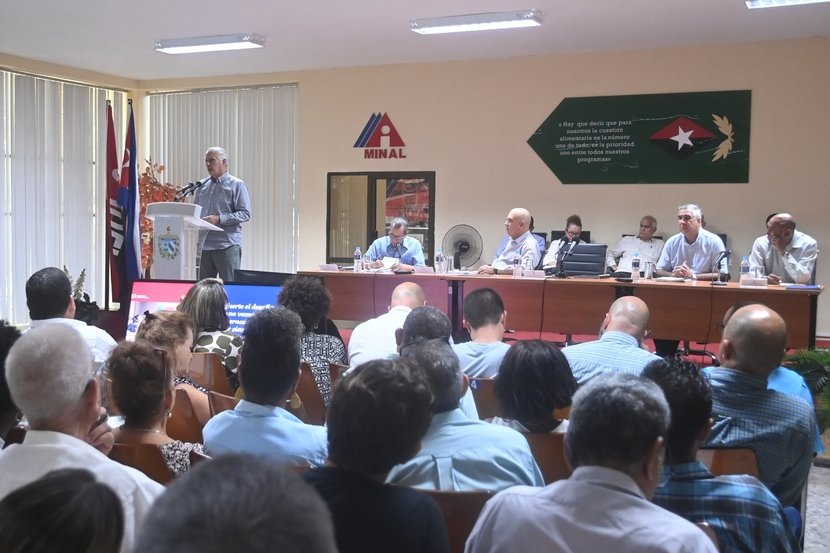
Foto: Estudios Revolución
Miguel Díaz-Canel Bermúdez, First Secretary of the Central Committee of the Communist Party of Cuba and President of the Republic, concluded this Tuesday the visit of the Secretariat and the auxiliary structure of the Central Committee to the state and business system of the Ministry of the Food Industry (MINAL), in a meeting with party members and sector workers.
At the meeting, held as the conclusion of the visit, participants evaluated compliance with measures supporting the implementation of the Economic and Social Transformations and the attention given to proposals from workplaces, according to Presidency sources.
Díaz-Canel emphasized that the food industry holds a strategic place in the national economy due to its link to food sovereignty.
The First Secretary recalled that this dynamic is part of the agreements of the XI Plenum of the Party's Central Committee, where it was approved to promote an economic and social transformation at a different pace.
The visit to MINAL preceded those carried out at the Ministries of Energy and Mines, Agriculture, and Public Health, as well as the National Institute of Hydraulic Resources and the Central Bank, and will continue in the coming weeks.
In the afternoon session, the head of the sector, Alberto López Díaz, explained that 100 of the 176 Economic and Social Transformations will be applied within the agency and its business system, across the 23 thematic axes that compose them.
López Díaz pointed out that the transformations represent an opportunity to advance the energy transition and increase generation from renewable sources, because more kilowatts mean more food.
During the debate, energy expert Laionel Concepción Pacheco underscored the importance of MINAL closing 2026 with nine percent renewable generation, a goal that will see a significant leap next year.
Osmany Castillo, general director of the Fruit and Vegetable Preserves Company, explained that the entity has 100 kW—ten percent of its demand—and that one of its factories installed 50 kW, matching its productive capacity, which enabled a surge in production, wages, and profits.
The company's plan is to cover 47 percent of its demand in 2027 through bank loans, he added.
Díaz-Canel stated that the food industry is one of the sectors with the greatest impact on public perception of the transformations.
"When one analyzes where public opinion trends lie among our population," he said, "one realizes that within the transformations, what people most immediately expect is fewer blackouts and more food."
The First Secretary argued that the performance of the Food Industry is directly proportional to the availability of food and basic consumer goods on the people's table.
"If we produce more food, if we increase the food supply, what will happen to prices?" he asked. "They go down. What will happen to inflation? It goes down. And what will happen to purchasing power? It increases," he added.
Díaz-Canel stressed that the central challenge is not only to produce more food, but to move from words to deeds and turn the transformations into greater production, more supply, better prices, more jobs, and higher incomes for families.
Regarding the role of the Party, he emphasized that its function is not to manage the enterprise, but to exercise political leadership, party oversight, and ideological support so that the transformations are implemented with results for the people.
"The 176 Economic and Social Transformations will not be implemented with circulars, nor with resolutions, nor even with laws. They are implemented with what is done in every factory, in every plant, in every workplace," he stated.
Also participating in the closing session were Political Bureau member and Secretary of Organization of the Central Committee Roberto Morales Ojeda, and Secretariat members José Ramón Monteagudo Ruiz, Jorge Luis Broche Lorenzo, and Yudi Mercedes Rodríguez Hernández, among other leaders.
Añadir nuevo comentario