
Harvard, the Last Thing We Needed
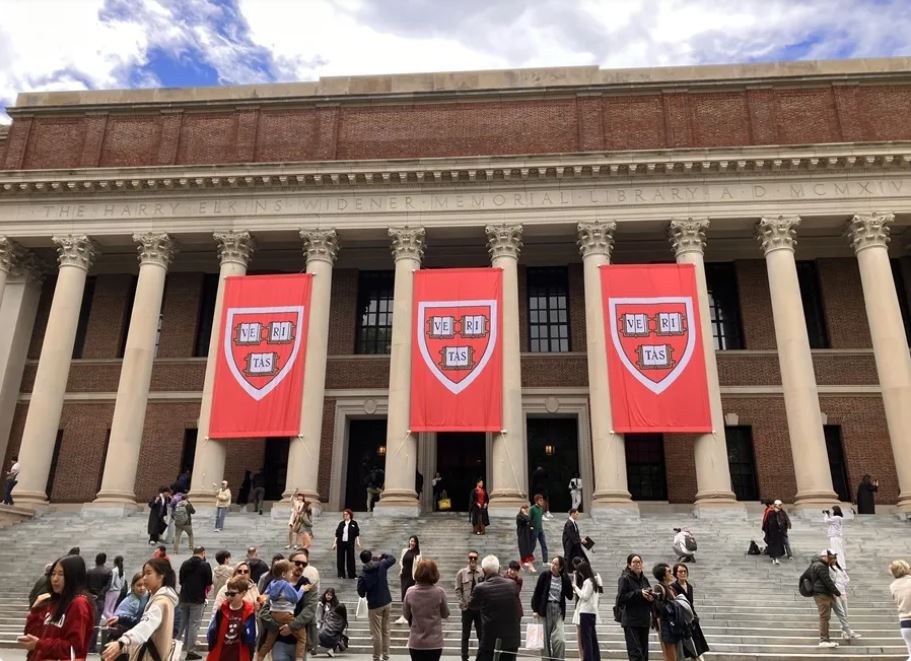
La Universidad de Harvard. Foto EFE
The illustrious Harvard University, founded on October 28, 1636, at the time as a Puritan school in the British Colony of Massachusetts Bay, became over time a referential university center, at least for the so-called Western culture and academia.
It is known that Harvard has been characterized by a tendentially progressive bias predominating in the works and opinion articles published by its professors. So, fairly speaking, what comes out of this university is generally taken as demonstrative of progressive, or liberal, thought, as Americans call it.
Having shown Harvard's historical and global perspective, it turns out that the recent report emanating from that university regarding Cuba was the last thing needed to complete the picture of threats—whether covert or overt—that this country has historically suffered, but with renewed perversity, since Marco Antonio Rubio García has headed the empire's diplomatic system.
In these 606 days of the Trumpist government (as of 9/18/2026), practically everything against Cubans has been seen. From the most extreme sanctions and blockades to the message periodically announcing a possible military aggression.
The aforementioned has been accompanied by a special media effort, passing through the paraphernalia generated in Miami, where they loudly call for bombing Havana, to little campaigns referring to the threat posed by the existence of some 300 drones in Cuba—it even sounds ridiculous, but well, that was what Axios published, a kind of official press organ of the State Department, passing through USA Today, Politico, as well as major media, all with nuances, speculating about a more or less imminent invasion.
This artificially contrived climate has been articulated with the warlike messages of senior government figures themselves, starting with President Trump, who promised Cubans to send them an aircraft carrier—another absurdity—and the slyly ambivalent phrases, whether from the secretary of war, Hegseth, or from Marco Antonio Rubio García, who was given the task of conducting the attacks, both in the terrain of rhetoric and in the imposition of the battery of periodic and new sanctions.
Given the way real reality is evolving, both the internal situation in the U.S., which is enough for an entire thesis, and the quagmire into which the aggression against Iran ultimately turned, with long-term consequences for the empire's hegemonic ambitions, the picture closes, as far as Cuba is concerned, with an increasingly "improbable" military "solution" to the conflict that the empire has invented against the small neighboring island since 1959.
In that context, in which the concrete circumstances have changed, now appears "the progressive version," with academic backing, supposedly neutral and objective, as if that existed, emanating from Harvard, which is usually taken as a place where revealed truth is elaborated—another thing that also does not exist.
And since the military variant has been relegated, for now, a "peaceful" exit gains strength, of course, with the same purposes: to intimidate, divide, and confuse, both Cuban public opinion, those in solidarity with Cuba, and of course, the American public itself.
One might think that the proposals of the report issued at Harvard are at least less violent; perhaps someone might even celebrate or want to sell the idea that it is even convenient for the Cuban government, whose legitimacy they admit—without saying so!—out of pure meanness, and they support the idea of the need for it to be maintained, in what they call a transition period, which includes a constitutional reform that modifies, obviously, the current Cuban political system. In short, a regime change done smoothly and without firing a single shot.
Thus, the report seeks to present a version of what the political shell of a Cuba would look like, which they imagine dominated by big American capital, whose advance is the primary objective of all, and which therefore unites both sides, if one accepts that what Harvard has is another variant different from the policy of Rubio García and company.
Among those who sign the report, not all are representative of the counterrevolutionary ruse behind it; nevertheless, given the specialty of some, "Cubanologists" as they are called, or their origin, it is easy to draw certain conclusions. Notable is professor and Harvard academic Jorge I. Domínguez, Cuban American for further details, or rather former professor, because he lost his high academic rank by decision of the University itself in 2018, for a case of sexual violence; it even makes one wonder if it is a kind of membership requirement among those who believe they have the moral authority to question the Cuban Revolution.
Another revealing aspect of the report on Cuba is that it draws on the opinions and materials provided by certain usual suspects, almost all participants in other "initiatives" on how to dismantle socialism on the island—you know, human rights, political prisoners, and other ruses, finely crafted to confuse and slander the work of the Revolution, in exchange for generous payments issued by the State Department—that is, mercenaries with purported intellectual solvency.
Beyond the report in question, certainly any version they want to present from the empire, no matter the supposedly diverse political tint, clashes with one reality: the ruthless nature of the aggression against Cuba, which someone has compared to what Gaza endures, but without the noise of bombs. A matter that, by the way, the Harvard people barely mention; they speak of the "embargo" as if it were a natural category, like the weather.
The report appears when it is visible that the imperial attitude faces sustained and growing international rejection, practically on par with solidarity with the heroic Palestinian people. And for some curious reason, perhaps due to the arrogance of the decision-makers in Washington, sometimes it gives the impression that this consequence—universal repudiation—was not in their calculations.
This explains the evolution of the imperial narrative. To begin by recalling that, arrogance aside, Rubio García stated in a "distant" 2025 that they had arrived at the "throne in Washington" to "guarantee peace through strength," period, and whoever doesn't like it can move.
After the above, already in 2026, the secretary of state has made an effort to justify the measures against Cubans, issuing delusional explanations claiming that Cuba is an existential threat, that it has the best espionage service in the world, and even that from Havana they control every American who protests and mobilizes in the U.S.
Undoubtedly, the incompetence of the designers in the State Department ultimately obliges and contributes to the emergence of actions that, from other political corners, attempt to guarantee extreme imperial hostility and the defeat of the Revolution.
That is the gravity of what was presented at Harvard regarding Cuba: selling itself as something different, it seeks the same and reprehensible purpose, including intensifying the blockade, ultimately, seen under the aspiration that the hardships it causes Cubans will lead to a social explosion that topples—hopes Rubio García—or bends—imagine the Harvard people—the revolutionary government.
And do not forget, insist that anything moving now in the U.S. is tinged with the electoral environment; so is the Harvard matter, apparently alien to the chiaroscuro of this political process. It is evident that any complex issue, with several facets, well manipulated, can favor one or the other of the two parties in dispute. And it seems that the Cuban issue could be one of them.
The question does not end there. It is very suspicious that this report is published from Harvard's "progressive tribune" at a moment when trends are emerging, perhaps with interesting force, in the opposition Democratic Party frankly favorable to normalizing ties between the U.S. and Cuba, and in unison, a part of the American press, for example the New York Times, echoes the havoc that the implicit act of war in the current levels of blockade applied by Washington is leaving on the Cuban people.
The question then arises: does the Harvard report, certainly driven by sectors of the counterrevolution that move in "decent" garb, not also represent an effort to undermine the positions that, within the Democrats, point to reducing or modifying that traditional hostile policy of the empire against the Cuban nation? Seeing is believing.
In summary, history is there to understand the present and usually the future. And it is a fact that imperial policy against the Cuban Revolution has been bipartisan; it was under a Democratic government that the U.S. invaded Cuba, at Playa Girón, or that the infamous Helms-Burton Act was signed, which codified the blockade. The so-called Obama spring should deceive no one.
Fine, it is sensible, almost healthy to assume that a version regarding Cuba from the Democrats, given current circumstances, is if you will more bearable for Cubans. But beware of being fooled by any "siren song." At least in Cuba, no one believes them.
From the empire, not even a little bit, nothing—you know, Che said it. And better, to stay with what the leader of the Cuban Revolution, Fidel Castro Ruz, expressed at the time: "we will never accept lessons in democracy from those who have invaded, murdered, and plundered the peoples of the world."
End of communiqué, please send a copy to the Harvard rectorate, for its proper and timely distribution among its honorable faculty.
Translated by Sergio A. Paneque Díaz / CubaSí Translation Staff
Añadir nuevo comentario