
"Tell the World This Reality," Díaz-Canel Urges International Ecumenical Leaders
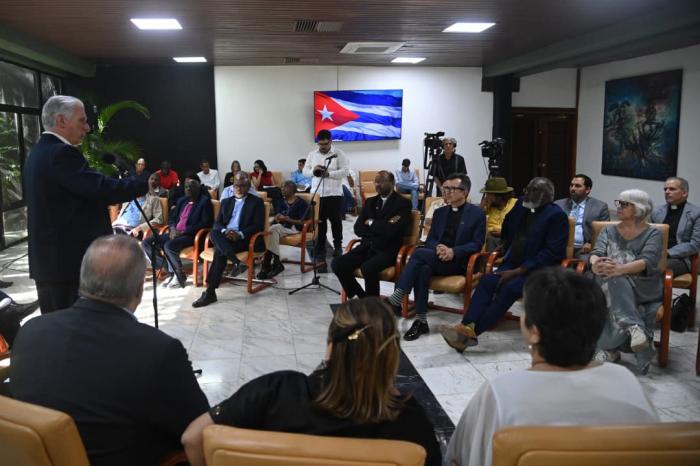
El Presidente cubano denunció que una economía de guerra impuesta por el imperio no pudo impedir la conquista de muchos avances. Foto: Estudios Revolución
"Thank you so much for being with us; thank you for standing by us; thank you for the message of peace and profound faith with which you accompany us." With these words, Cuban President Miguel Díaz-Canel Bermúdez addressed representatives of international ecumenical organizations on Monday afternoon, during a pastoral visit to Cuba coinciding with Holy Week celebrations.
Sincerity, fraternity, and a deeply human tone defined the dialogue held at the Palace of Conventions in Havana, where the president met with leaders representing 600 million Christians across approximately 120 nations. During their time on the island, the delegations had exchanged with various faith communities, participated in Palm Sunday activities, and engaged in conversations with Cuban pastors and religious leaders from several denominations within the Cuban Council of Churches (CIC).
Invited by the CIC and the Reformed Presbyterian Church, the foreign religious leaders — who witnessed firsthand the difficult conditions facing Cubans — heard President Díaz-Canel speak to the resilience of a country that refuses to be defeated. The meeting was also attended by Prime Minister Manuel Marrero Cruz and Roberto Morales Ojeda, Secretary of Organization of the Central Committee of the Cuban Communist Party, both members of the Political Bureau.
The president told his "dear sisters and brothers" and "dear friends" that it was a pleasure to receive them in Cuba at such a difficult moment. "We greatly appreciate, and attach great significance to, this visit, which reaffirms for us that Cuba is not alone," the head of state declared. Also in attendance were Caridad Diego Bello, head of the Office for Religious Affairs of the Central Committee, and Yuniasky Crespo Baquero, head of the Ideological Department of the Central Committee, among other officials.
Díaz-Canel noted that the visit speaks to relations that are historic in nature, and highlighted the symbolic weight of the delegation's arrival during Palm Sunday. "What we are living through," he said of the current hardships, "is an accumulative process of 67 years of blockade."
He acknowledged that Cuba has not been able to achieve all that it set out to accomplish — "many dreams we have not been able to realize" — but spoke of a creativity born of resistance that has made possible, he argued, a social accomplishment of enormous significance. The Cuban president denounced that a war economy imposed by what he called the empire had nonetheless failed to prevent many achievements, which "today are weighed down and diminished by the blockade" as it intensifies.
"In everything they do," he emphasized, "there is a collective punishment of the Cuban people." The reason, as the president explained to his guests, is "the example of Cuba — that in 67 years they have not been able to bend us or humiliate us."
Toward the end of his remarks, Díaz-Canel said: "The concept we have shared and defended is that we will not surrender. And what we ask of you — our visitors — is that, with the awareness and sensitivity you have shown toward Cuba and our people, you explain the harshness of this situation."
He described the blockade as "a violation of the human rights of Cubans" and as the act of "depriving a people who are generous, hardworking, and solidarity-minded of the most basic things needed to live their lives in peace." As a pointed example, he noted that "due to shortages of supplies, we have more than one hundred thousand people waiting for surgery — and of those, more than eleven thousand are children."
"Can anyone doubt that Cuba is capable of performing those operations?" he asked. "Why are we being denied the ability to do so? How can they then shamelessly claim that everything they do is for the benefit of the Cuban people?"
The president closed by urging the ecumenical leaders: "We ask that you demonstrate this reality, that you tell this reality — and that the leaders of our churches continue developing the community initiatives with which they have always supported us."
Voices Carrying Peace and Solidarity
All of the religious leaders' interventions began with expressions of gratitude for being received by Cuba's leadership. Jerry Pillay, Secretary General of the World Council of Churches, acknowledged that Cubans "are living through difficult times" and made explicit the purpose of the visit: "We are here to celebrate the beginning of Holy Week with you." He added: "We are going to join the voices of people of faith to say that what is being done to you is wrong. Our presence here shows that Cuba is not alone."
Anthony Poggo, Secretary General of the Anglican Communion, added: "As the scriptures say, when one suffers, we all suffer — and that is why we are with you."
Reynaldo Ferreira Leão Neto, Secretary General of the World Methodist Council, assured Cuba that it "can count on our prayers and our support." Other voices called for the rejection of war and violence, and of the deprivation of a people's food and hopes.
Joel Ortega Dopico, President of the Cuban Council of Churches, spoke with emotion, saying that the presence of the visiting leaders was a source of "wholesome pride for the Cuban ecumenical movement." He reflected: "They speak of the collapse of Cuba — but the one truly in collapse is this world." He called on all present to urgently raise their voices against war and in favor of peace, and noted that the high-ranking religious leaders "have left their churches and organizations to be here with us on Palm Sunday — the day the Lord, riding on a donkey, defied the empire and all the powers of a world as unjust as today's."
The afternoon concluded with a prayer in which the religious leaders interceded for Cuba, for the resilience and hope of an entire people, and for their leaders in a moment laden with challenges and decisions.
Añadir nuevo comentario