
Cuban President Calls for Urgent Transformations to Economic and Social Model
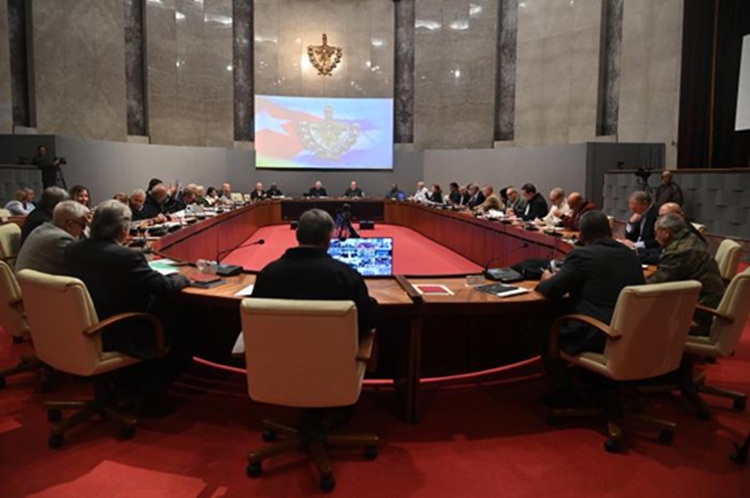
Foto: Estudios Revolución
“We must immediately focus on implementing the most urgent and necessary transformations to the economic and social model,” stated the First Secretary of the Central Committee of the Communist Party and President of the Republic, Miguel Díaz-Canel Bermúdez, during a Council of Ministers meeting.
The President highlighted that these transformations are primarily related to business autonomy, municipal autonomy, restructuring of state institutions and government bodies, national food production with municipal oversight, energy matrix changes—including domestic crude and renewable sources—exports linked to foreign investment flexibility, partnerships between state and private sectors at the municipal level, and promoting business with Cubans residing abroad.
“All of this must contribute to macroeconomic stabilization, increased foreign currency income, and the development of national production, particularly food,” Díaz-Canel added.
The meeting, chaired monthly by Prime Minister Manuel Marrero Cruz from the Palace of the Revolution via videoconference with all provinces, emphasized that achieving these objectives largely depends on the performance of the business system and municipal administration.
Companies must be prepared to fully exercise the authorities granted under new autonomy regulations, many of which are not yet fully utilized or even known, according to the President. Municipalities also need to prepare, as an increasing number of these processes will be executed locally.
“Municipalities must manage foreign direct investment; their own closed foreign currency schemes; economic partnerships between state and non-state sectors; design local production systems; and manage investments with Cubans residing abroad,” Díaz-Canel exemplified.
The President called on the Council of Ministers to work intensely, with intelligence, oversight, in-depth analysis, discipline, and by leveraging potential while questioning any processes that fail to advance.
Economic and Social Program for 2026
During the session, Prime Minister Manuel Marrero Cruz presented updates to the Government Program, incorporating the XI Plenary Committee agreements, the latest National Assembly session, public consultations, and expert recommendations. The program retained ten general objectives while adjusting specific targets, actions, and indicators. Its new title is “Economic and Social Program of the Government for 2026,” to be published in March and updated annually.
Díaz-Canel emphasized that this program guides current economic activity and must be widely disseminated across national and local government structures.
Cuban Economy as of January 2026
Minister of Economy and Planning Joaquín Alonso Vázquez reported that while some goods exports fell short of targets, products such as honey, mechanized tobacco, lobster, rum, and biopharmaceuticals met commitments. Service exports performed strongly, with health sector services nearly 100%, tourism at 85%, and telecommunications exceeding projections.
Autofinancing schemes in foreign currency have been approved in 86 sectors, including transportation, industry, oil, coal, fishing, tobacco, sugar, and food production. Agricultural production, while progressing, remains insufficient to meet domestic demand and replace import deficits. Prices grew 0.67% in January, with a 12.5% year-on-year increase due to liquidity and supply deficits.
Social protection programs currently cover 178,666 families and 303,298 beneficiaries, including 63,788 vulnerable mothers with three or more children. Social transformation actions are ongoing in 1,249 communities.
Prime Minister Marrero Cruz stressed that national priorities focus on food production and energy matrix transition, with municipalities playing a central role. Municipalities are being delegated the approval of non-state economic actors, with progress also made toward local approval of small and medium state enterprises and the creation of new businesses.
Energy Transition
Minister of Energy and Mines Vicente de la O Levy noted that municipal progress in energy transition remains slow. Actions such as solar panels for hospitals, schools, and other facilities are underway, but municipalities must develop comprehensive sustainability strategies using local resources. Nine municipalities have completed designs, but more action is needed.
State Budget
Minister of Finance and Prices Vladimir Regueiro Ale reported that the 2025 State Budget Law was met with good performance in subsidies, tax collection, and positive current account balance. Local budgets show surpluses, with provinces such as Artemisa, Havana, Mayabeque, Matanzas, and Villa Clara performing strongly.
For 2026, including territorial contributions, municipalities will have over 9 billion pesos available for local development projects. The government also reviewed overdue accounts, accountability reports, and approved a new policy and decree for strategic territorial development to promote sustainable use of local resources.
The National Employment Survey 2025 highlighted the high educational level of the workforce, with 77.9% having pre-university, technical, or higher education.
Finally, the Council reviewed the results of the Mariel Special Economic Zone Development and Business Program, confirming its strategic value for domestic and foreign investment despite Cuba’s challenging situation.
Añadir nuevo comentario