
Between Tradition and Legend: The Ceiba Tree of Havana's El Templete
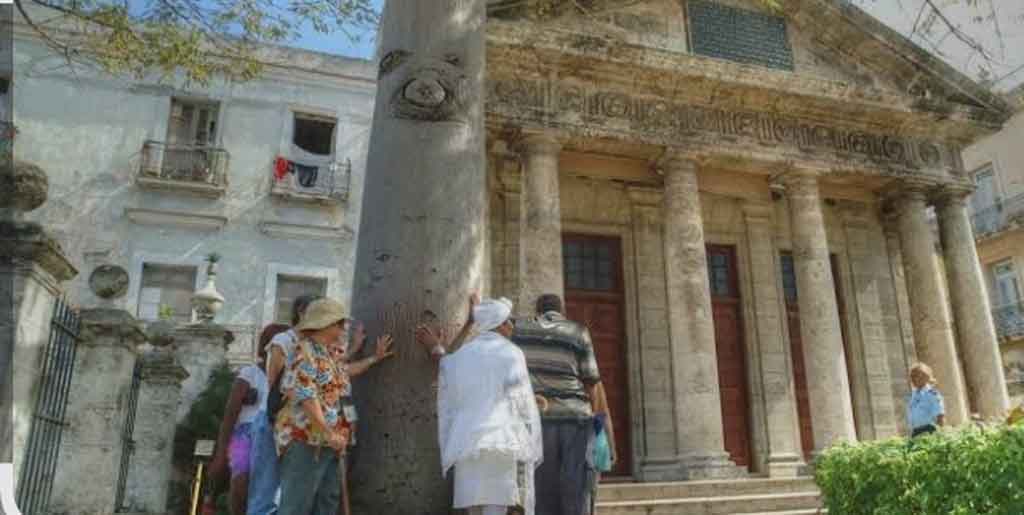
La ceiba original fue testigo durante décadas de ese hecho histórico, pero también devino en objeto de culto.
The original ceiba tree stood for decades as a witness to that historic event, while also becoming an object of devotion.
Legend holds that the most auspicious day to plant a ceiba tree is November 16, the feast day of Saint Christopher, patron saint of Havana. Belief in the tree's sanctity has been passed down from generation to generation in Cuba, rooted in pre-Columbian and African cultures as well as Cuban religious syncretism.
According to a centuries-old tradition, during the early hours of November 16, many people walk around the ceiba three times counterclockwise and make a wish. Some leave coins or other religious offerings near its base, hoping for a miracle.
When Francisco Cagigal de la Vega, Governor-General of the island, ordered a commemorative column erected on the site in 1754, the original ceiba tree no longer existed.
Between 1755 and 1757, three ceibas were planted around the spot where the original tree had stood. Two of the saplings eventually withered, and the third was felled in 1827 to make way for the construction of El Templete.
In 1828, three more ceibas were planted, though only one survived, remaining on the site until 1960 after a long life of just over 131 years.
Despite efforts by scientists to save the century-old tree, it could not recover; consequently, another was planted in 1960 that lived for 56 years, until February 9, 2016.
On March 15 of that same year, a young ceiba—approximately 15 years old and standing about eight meters tall, brought from Las Terrazas in Artemisa—was transplanted to the site, and it is the tree that can be seen at El Templete today.
At times, the ceiba is seen surrounded by hens, plantains, and other offerings, serving as a unifying symbol across different religious beliefs whose followers gather around it to perform rituals, affirming the nation's cultural syncretism.
According to Mayan creation legends, this tree spreads its main branches toward the four cardinal directions, thereby uniting with the fourfold deity that governs the winds and rains.
It is said that reverence for the ceiba was brought by enslaved Yoruba Africans whose culture venerated sacred trees; in their tradition, the tree is a dwelling place for the orishas and represents the focal point where all the energy of ancestral spirits is concentrated. Walking around the sacred tree, touching it, embracing it, and even kissing it attracts prosperity in Yoruba custom.
Through contact with Catholicism during Spanish colonization, a religious fusion emerged that enriched both deities and saints with shared points of connection.
It is remarkable to observe how, despite differing beliefs, faith unites Cubans each year around this historic tree as they ask primarily for health and prosperity, turning it into a source, cause, and symbol of solidarity and social empathy.
Standing at the foot of the ceiba in 2017, the late City Historian Eusebio Leal Spengler remarked: "Havana is now, and will undoubtedly continue to be, more beautiful. Come cyclones, winds, bans, and blockades, we will always be capable of emerging, breaking through the wall, and moving forward. That is the history of the tree, and it is our history. It is like the tree of life; in its shade we take shelter."
Añadir nuevo comentario