
Vigilance Remains Key Against Hantavirus
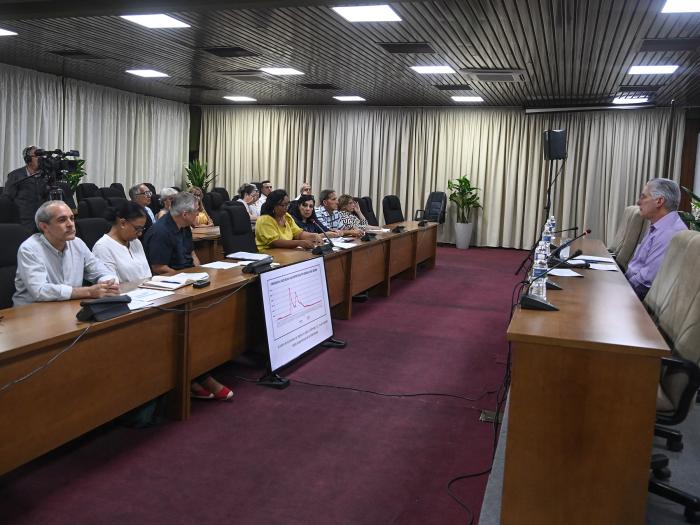
Foto: Estudios Revolución
Presided over by the First Secretary of the Central Committee of the Communist Party and President of the Republic, Miguel Díaz-Canel Bermúdez, a meeting of experts and scientists on health issues was held this Tuesday at the Palace of Conventions in Havana. The agenda focused on updating the hygienic-epidemiological status of the island.
"I believe that with the clinical-epidemiological surveillance system we have, the experiences gained from COVID-19, and the international guidelines set by the Pan American and World Health Organizations, we possess the necessary conditions to timely detect the introduction of the disease into the country," stated Dr. Carilda Peña García, Vice Minister of Public Health, while speaking to reporters on Tuesday afternoon.
Her statements followed the high-level meeting where health authorities addressed an emerging global challenge: the Hantavirus outbreak. The situation traces back to May 2, 2026, when the World Health Organization (WHO) was notified of a group of passengers with severe respiratory illness aboard a cruise ship in the Atlantic Ocean. The vessel carried 147 people from 23 nations and had departed from Ushuaia, Argentina, on April 1, 2026, following an itinerary through remote and ecologically diverse regions.
By May 8, the WHO reported eight cases—six confirmed and two suspected—resulting in three fatalities. Laboratory results confirmed the pathogen as the Andes virus. Dr. Peña noted that these events "undoubtedly trigger health alarms and epidemiological surveillance; and, of course, those of Cuba, which maintains a solid surveillance system."
The Doctor explained that Hantavirus is not known to exist in Cuba, and there are no historical records of domestic outbreaks. However, it is a recognized threat in the Americas (specifically Argentina and Chile), Asia, and Europe. While Hantavirus is typically transmitted by rodents, the Vice Minister clarified that among the 14 species of rodents found in Cuba, none are known carriers of this specific virus.
Regarding the risk to the Cuban population, Dr. Peña emphasized: "It is a disease transmitted to humans through contact with the excrement or saliva of infected rodents. The Andes strain, which caused the cruise ship outbreak, is also documented for person-to-person transmission through close and prolonged contact."
A critical factor discussed was the disease's long incubation period, which can last up to eight weeks. "This means that individuals who have had close contact with infected persons must undergo a surveillance period of up to eight weeks, as they could be incubating the disease during that entire time," the expert warned.
The illness can manifest as two severe conditions: renal syndrome and cardiopulmonary syndrome. Consequently, health officials urged citizens to seek medical attention if they have been in contact with anyone arriving from a verified outbreak zone.
When asked about the possibility of the virus entering the country, Dr. Peña admitted the risk exists due to the lengthy incubation window. She highlighted that international sanitary control authorities at ports, airports, and marinas are conducting rigorous inspections of aircraft and vessels for signs of rodents.
"We have the lessons learned from COVID-19, which is also a respiratory disease," she said. "This is a situation the population should be aware of—not to cause alarm, but to ensure they are informed, particularly regarding individual protection." She recommended the use of face masks for those with acute respiratory infections and emphasized the importance of universal precautions like handwashing.
Addressing the potential for a pandemic, the Vice Minister cited the Director of the WHO, noting that while more cases may appear during the evacuation and monitoring of the cruise ship, the current situation does not classify as a pandemic similar to COVID-19. This is due to the specific transmission mechanisms and the existing medical knowledge on how to manage the clinical cases.
"It is a matter of surveillance, of staying informed, and following developments," Dr. Peña concluded. She urged Cubans traveling abroad to research whether the virus is circulating in their destination and to report their epidemiological history upon returning to the country.
The meeting also reviewed research lines from the Center for Technological Applications and Nuclear Development (CEADEN) focused on healthcare solutions, underscoring Cuba’s ongoing commitment to scientific advancement in defense of public health.
Add new comment