
Díaz-Canel Led the Meteoro 2026 Exercise
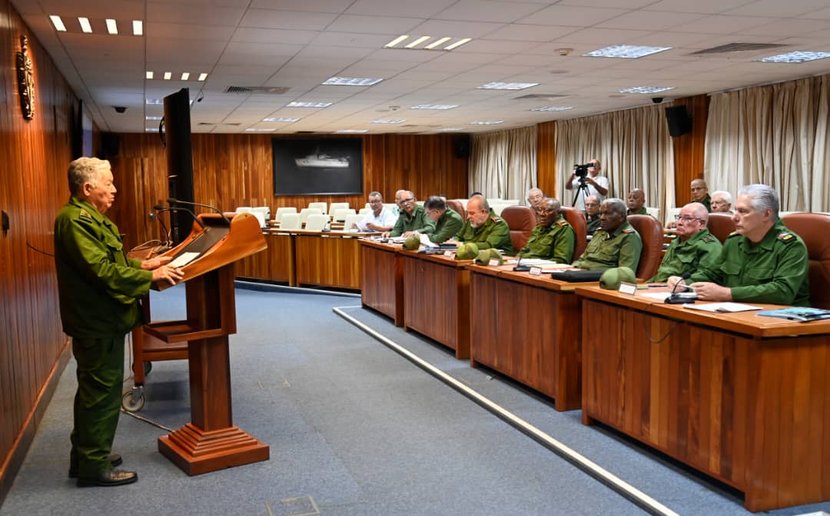
Encabezó Díaz-Canel ejercicio Meteoro 2026
Miguel Díaz-Canel Bermúdez, President of the National Defense Council, led the 40th edition of the "Meteoro 2026" Popular Exercise for Disaster Actions today, which constitutes an essential pillar for the preparation of management and command bodies, as well as the general population.
During the event, the president referred to the complex situation Cuba is experiencing as a result of the genuine and criminal policy of the United States government.
During the working session held at the Ministry of the Revolutionary Armed Forces, Army General Raúl Castro Ruz, leader of the Cuban Revolution, sent a greeting to all participants and invited them to carry out this essential preparation exercise with high quality, as highlighted by the Presidency's website.
Division General Ramón Pardo Guerra, chief of the National Civil Defense Staff, explained that Meteoro 2026 provides an opportunity to continue assessing vulnerabilities, improving surveillance systems, and strengthening the preparation of the population, forces, and resources for disaster response and recovery.
The president noted that this exercise provides continuity to the preparation practices developed by the country over all these years and to the rich tradition in Civil Defense matters.
He called for supreme creativity given the conditions under which the exercise is being conducted and urged participants to take advantage of these sessions to update their plans.
"Everything must be specified, implemented, and finalized, defense zone by defense zone," he indicated.
Díaz-Canel mentioned two recently approved executive orders as part of the U.S. government's policy of suffocation: one declaring an energy blockade against Cuba, and another that extraterritorializes sanctions toward anyone wishing to work with the island.
Within the framework of the exercise, Celso Pazos Alberdi, director general of the Institute of Meteorology, reported that the hurricane season is expected to be poorly active, with the formation of eleven tropical cyclones.
Of these, five could reach hurricane status, two of which could become intense hurricanes. The probability of Cuba being hit by a cyclone is 40 percent, slightly above the general historical average. In the case of a tropical storm, the risk increases to 75 percent.
Argelio Fernández Richelme, director of Hydrology and Hydrogeology of the National Institute of Hydraulic Resources, reported that the national rainfall accumulation during the hydrological year that concluded in April was 1,184 millimeters, representing 89 percent of the historical average, a behavior described as "very low."
He specified that 102 municipalities are experiencing hydrological drought, with the most unfavorable conditions in the western region, from Pinar del Río to Matanzas, and from Ciego de Ávila to parts of Camagüey. At the close of the period, the country held 56 percent of its national storage capacity.
Carilda Peña García, Vice Minister of Public Health, referred to the country's epidemiological situation and warned that today, the control of international travelers, ships, and aircraft arriving at ports of entry, as well as primary health care, is of vital importance.
She spoke about the essential nature of epidemiological analysis in each territory to make timely decisions and to ensure the means for epidemiological surveillance, as well as the sale of sodium hypochlorite in pharmacies and easily accessible locations for the population.
Add new comment