
Cuba's Response to Trump's Latest Threat
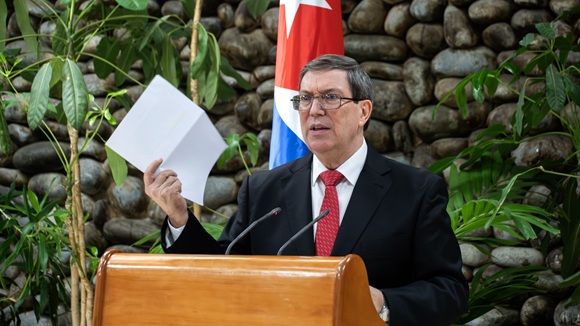
Foreign Minister Bruno Rodríguez Parrilla categorically rejected "any U.S. threat" against Cuba, after U.S. President Donald Trump stated on October 23 that he would send a warship near the island—once military operations in Iran conclude—with the aim of forcing Cuban authorities to sign an "agreement."
"We reject any threat regarding U.S. ambitions toward Cuba. On our coasts there are beautiful beaches, but also dog-tooth rock, inhospitable for those who arrive with hostile purposes and eagerness for domination. Cuba is not a threat; the blockade is," the Cuban foreign minister wrote on X.
"Pass By There on the Way Back from Iran"
That same day, Trump stated at a campaign event in Florida that he would have one of the warships currently in the Middle East for the war against Iran stop "about 50 yards from the coast" of Cuba.
"We'll make a little stop. Actually, what we'll do with respect to Cuba is pass by there on the way back from Iran. Those beautiful ships will pass in front of Cuba. We'll have one of them stop about 50 yards from the coast," he said before those present.
To this he added that, according to his forecast, the Cuban Government "will raise its hands" and his Administration will send Secretary of State Marco Rubio "to close the deal."
Threats and Preparation
It is not the first time the U.S. leader has threatened to militarily attack the island. Last June 4 he declared: "We're going to take care of that—Cuba—as soon as we've finished [with Iran]. I like to do one thing at a time." And last April he promised exactly the same, hinting that the Caribbean country would be a future target of Washington's military actions.
At the time, Cuban authorities interpreted those expressions as an attempt aimed at "creating confusion to continue preventing the entry of fuel into Cuban territory," as Rodríguez Parrilla pointed out at that moment.
Nevertheless, despite this, in recent months various territorial defense strategies have been deployed in Cuba, which in the words of President Miguel Díaz-Canel constitute a task of "enormous priority" in the face of a possible military aggression.
The U.S. Siege Against Cuba
Last January 29, Trump signed an executive order declaring a "national emergency" over the supposed "unusual and extraordinary threat" that, according to the White House, Cuba represents for the security of the North American country and the region.
The document accuses the Cuban Government of aligning with "numerous hostile countries," of harboring "transnational terrorist groups," and of allowing the deployment on the island of "sophisticated military and intelligence capabilities" of Russia and China.
Since then, the U.S. has intensified the economic and commercial blockade imposed on the island for more than six decades, with the application of numerous coercive measures.
Additionally, Washington announced the imposition of tariffs on countries that sell oil to the Caribbean nation, to which are added threats of reprisals against those who disregard the White House executive order.
The Cuban Government has systematically rejected those accusations and has warned that it will defend its territorial integrity.
Add new comment