
Bukele, Faded Away
“In Cuba, you don’t see children sleeping in the streets, like you see even in Paris,” said the current Salvadoran president, Nayib Bukele, when he was a presidential candidate. He even cited the Cuban healthcare system as an example for everyone. Now, under the auspices of his American counterpart, Donald Trump, and in close alliance with Trump's foreign minister, Marco Rubio, he seems to have forgotten all the good things about Cuba, criticizes it—forgetting his past statements against the embargo—and blatantly lies about Che Guevara.
Without any need and completely out of context, Bukele has criticized the Cuban system of government, either because the empire has demanded it or because he has offered to do so himself.
At the groundbreaking ceremony for the El Pacífico airport in eastern El Salvador, Bukele told the guests that he wants to make El Salvador “a free country, but not like the countries they admire, their role models (referring to the left). There’s no freedom there, and there’s no chicken. You can't find a single piece of chicken in all of Cuba,” he said.
Earlier, at a meeting of Latin America's wealthiest business families, he said: “We want to build a country that is attractive, competitive, and thriving. That in ten years we will be more like the United Arab Emirates or Singapore, and not like Cuba,” conveniently omitting the effects of the US embargo on the Cuban people.
Likewise, “the left has seized upon causes like lifting people out of poverty. It’s a lie; they’ve never done it. The only thing the left has been good for is creating poverty, forgetting that during their five years in power, poverty increased by 3.48%. By 2024, the number of people living in poverty totaled 1,289,405.
The poor are persecuted in the historic centers of municipalities, starting with the capital, where the most they can hope for is becoming street vendors, thus increasing poverty rates. This happened during the successful tour of the talented Colombian artist Shakira, which generated a positive balance of 120 million dollars, which, it was claimed, would be dedicated to improving sanitary conditions.
In this context, it’s worth remembering that the previous government of Sánchez Cerén allocated more than six million dollars for the construction of a hospital, which was never built, but a mega-prison was erected in less than 12 months.
MORE POPULAR THAN PACHITO ECHÉ?
Although he didn't combat the root causes of crime, but rather its consequences, Bukele's hardline policy, with periods of exception that still persist, virtually eradicated the problem, bringing relief to a long-suffering population that supports him by around 90%, a figure acknowledged by his opponents, who hesitate to defeat him if he runs for a third term.
This popularity, comparable to that of the Antioquian Pachito Eché—as immortalized by Benny Moré and Dámaso Pérez Prado's orchestra—helped him violate the rules of coexistence, which, combined with a favorable judiciary and legislature, strengthened his close relationship with Trump and his main bodyguard, the Miami native Marco Rubio, of unfortunate Cuban origin.
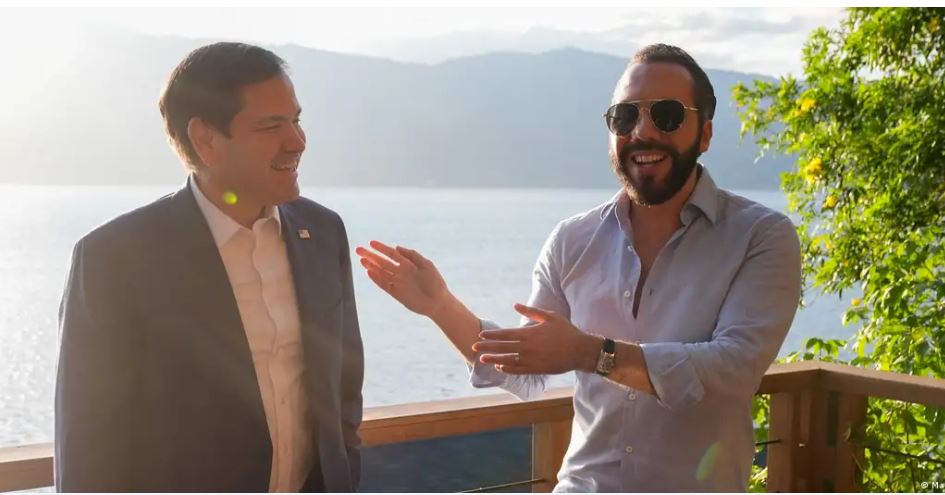
I still remember that idyllic image of the president with the hater leaning against a railing of the presidential palace, after which—I don't know if it was Bukele's or Rubio's idea—the latter declared to the press that "no country has ever done this to us." “An offer of friendship like this,” alluding to the agreement reached, according to which El Salvador will take back its undocumented citizens in the U.S., as well as convicted migrants of various nationalities, such as those from the Tren de Aragua gang, and American criminals.
Bukele himself announced that he is making the Terrorism Confinement Center (CECOT) available for this purpose. This controversial maximum-security mega-prison has a capacity for 40,000 inmates, but has continued to grow and now houses 100,000, not counting some 10,000 released prisoners who were found not guilty of any crime. The offer is for the paltry sum of seven million dollars, which is insufficient to sustain El Salvador’s prison system.
Is this fee solely a financial exchange? What details lie behind the words of friendship between Rubio and Bukele?
José Marinero, a lawyer and public policy specialist, points out that in the United States There are leaders of the MS-13 gang who are being prosecuted for cases that could be related to the truce that, according to investigations by local media, was negotiated by the Bukele government with the MS-13 and Calle 18 gangs.
“By achieving their deportation, El Salvador would regain control over individuals who, before a judge, could present evidence proving that the Salvadoran government, under Bukele, negotiated and agreed to deals with the gangs,” Marinero told the German news agency Deutsche Welle.
Another possible quid pro quo would be more favorable treatment for Salvadorans in the United States, commented a political scientist from El Salvador who, according to DW, preferred to remain anonymous for fear of reprisals.
The truth is that the deal represents US backing for the controversial security policies implemented by Bukele in recent years, in his objective to eradicate gangs and crime.
“Rubio’s agreement with El Salvador gives relevance to what has been done in public security in our country,” Luis Contreras, a political and citizen security advisor, told CNN. If the US sends criminals to the mega-prison, it’s because he is confident that “they will not have the possibility of “Escape,” he emphasized.
Crime has certainly experienced a sharp decline in recent years in El Salvador, where, I stress, a state of emergency has been established and is now considered a matter of state policy.
The fact is, it's not taken into account that locking up criminals with others who haven't been properly investigated and punished in a prison of this type opens the door to creating a breeding ground for criminals where, instead of fighting crime, a breeding ground for its spread is fostered.
Bukele doesn't consider this. His hatred for President Nicolás Maduro led him to admit more than 250 Venezuelans sent by Trump, who later returned to their country through a prisoner exchange, as well as to celebrate the president's kidnapping during the recent US military aggression against Gran Caracas, and to subject him to a trial based on falsehoods about narcoterrorism and its ties to the so-called Tren de Aragua gang, which, as was later admitted, never existed.
Add new comment