
Argentina for the USA, According to Milei
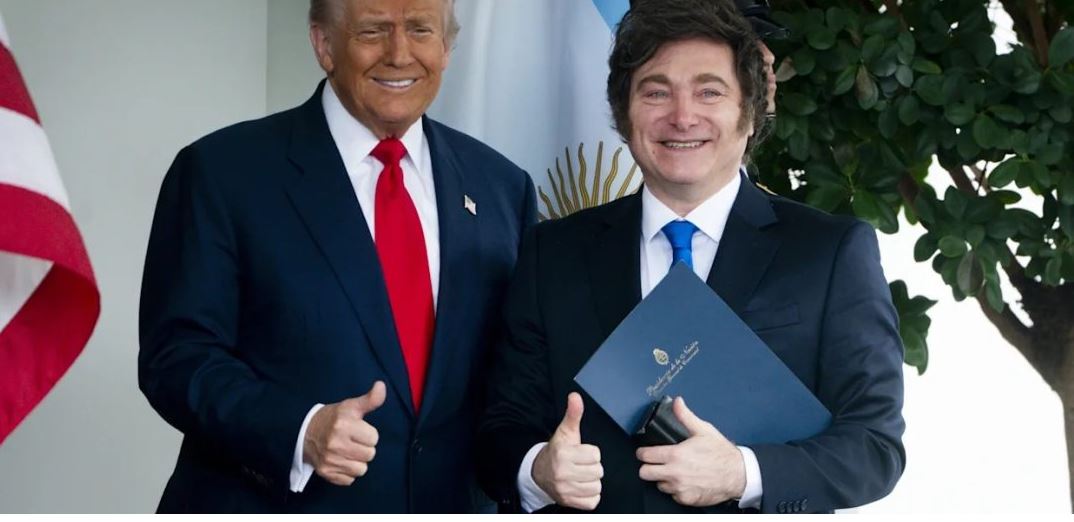
An Argentine friend told me not long ago that for Milei, Macri, and all like them, 20, 30, or 50 billion dollars is nothing, because they quickly make it disappear through handovers and capital flight. “We’ll be in Dante’s oven for many years, and all thanks to a large part of the ignorant, brutish people who voted for him. We’re left without a country,” he remarked, while another, equally complaining about how the aforementioned man took advantage of the division and opposing perspective, made his displeasure even more blatant, because the long-haired one had just handed the country over in an agreement tailored to the United States’ needs:
“I urgently need to go to the bathroom. Who do I have to ask for permission? The IMF or the U.S.?”
Under the guise of “prosperity” and openness to the world, the Executive Branch signed a trade and investment agreement with the United States that deepens economic dependence, weakens national industry, and consolidates a model of internal adjustment and external business for the benefit of a select few.
Milei celebrated by dancing and singing—he should have tried to dedicate himself to that—as if it were a historic achievement. Photos, smiles, and grandiose phrases accompanied an announcement that, far from charting a course for sovereign development, confirms a policy of automatic alignment and economic subordination to the continent's leading power.
There's no surprise: the agreement fits perfectly with the official economic program, as Página 12 reminds us: indiscriminate opening, deregulation, withdrawal of the State, and blind faith that foreign capital—this time, American—will come to "save" an economy devastated by austerity. Argentine history, however, is already familiar with this script: Investment promises that never materialize, a declining industry, and workers footing the bill.
While agreements are being signed abroad, domestically unemployment is rising, real wages are falling, and consumption is collapsing. The contrast is stark: sacrifices for the majority, guarantees for corporations. Because that's what these kinds of pacts ensure: legal security for capital, easy repatriation of profits, and rules of the game that favor large companies, not the local productive sector.
Local economists warn that the government is selling the agreement as an opportunity for international integration, but it's omitting a key fact: the relationship with the United States is profoundly unequal. There's no possible symmetry between a peripheral economy in crisis and a superpower that protects its market, subsidizes its production, and shamelessly defends its strategic interests. This is especially true when legal security and easy repatriation of profits are granted, allowing the country to place all its products without obstacles, facilitating access to critical minerals, and requiring the sharing of data, among other things.
FAREWELL TO SOVEREIGNTY
Unlike Carlos Gardel, who sadly left his Pampas to go to foreign lands, Milei was beside himself with joy when he sold the country's sovereignty to such a powerful and voracious nation.
The impact on small businesses, national industry, and employment appears as acceptable collateral damage for the ruling party. Trade liberalization, in a country without protectionist or development policies, does not generate healthy competition; on the contrary, it generates productive destruction. More imports, less local production, more precarious employment.
All of this is moving forward, moreover, without public debate and with opacity. The clauses of the agreement, as well as its future conditions, are not known in detail. Congress, where the agreement must be sent, appears sidelined, and society is excluded from a decision that compromises the country's economic course.
Far from being a mistake or naiveté, the agreement with the United States expresses a clear political decision: to abandon any attempt at autonomous development and accept the role of supplier of raw materials and market for foreign goods. This is not a smart insertion, but a planned surrender.
EFE corroborates this, pointing out that Milei is staging his alignment with Trump through the trade agreement that limits Argentina's development possibilities to an asymmetrical relationship with the US and could strain relations with Brazil and China.
ALL IN FAVOR OF THE EMPIRE
AFP explains that the so-called Reciprocal Trade and Investment Agreement with the United States, which must be a formal agreement ratified by the Argentine Congress, directly impacts natural resources and local production, benefiting Washington. The pact includes many more obligations for Argentina: the host country, without any compensation, its authority over quality control in industries such as pharmaceuticals, food, and automotive. For example, it will have to accept the import of US vehicles manufactured according to the Federal Safety Standards, and previous emissions of the FDA's (Food and Drug Administration) for medical devices and pharmaceutical products.
The Argentine Foreign Ministry has justified the signing of the agreement by stating that it will promote exports: “Washington will eliminate reciprocal tariffs on 1,675 products from a wide range of productive sectors, which would allow for the recovery of $1.013 billion in exports,” reported the Ministry headed by Pablo Quirino, who was responsible for signing the document.
In return, “Argentina will eliminate tariffs on 221 items, reduce tariffs to 2% on another 20, mainly auto parts, and grant quotas for vehicles, meat, and other agricultural products imported from the US.”
Argentine experts reject the notion of a symmetrical relationship, given the United States' enormous trade GDP, and the opening of the trade agreement in the context of a cold war between the Trump Administration and China, which further harms industry and sectors that generate employment.
Pedro Gaite, economist and head of FIDE (Foundation for Economic Development), told elDiario.es that “a free trade agreement with a country that has a much higher level of productivity than Argentina only deepens traditional center-periphery relations, and this could lead to an increase in the primary sector's reliance on raw materials in the local production structure. Argentina exports more primary products and raw materials and imports more high value-added manufactured goods with high technological content.”
According to Gaite, the agreement could also have a negative impact on Argentina's trade relations with other Mercosur countries—a bloc it forms along with Brazil, Paraguay, and Uruguay—and, in particular, with Brazil. “The vast majority of exports Industrial goods from Argentina go to Mercosur countries, especially auto parts to Brazil. This trade agreement significantly raises tariffs on US auto parts, so it's very likely that the sectoral trade agreement for automobiles with Brazil will enter into crisis, which is already happening, but it's likely to deepen.
In short, the United States found in Milei an unconditional partner who chooses him over China and Russia and no longer votes with Brazil, especially not with Luiz Inácio Lula da Silva as president, toward whom he has made no secret of his animosity.
The ultra-Argentine leader received crucial help from Trump that allowed him to comfortably win the legislative elections last October. The election seemed uphill battle amid economic turmoil and fears of devaluation, but US Treasury Secretary Scott Bessent announced a $20 billion financial bailout contingent on the current government's victory.
The moral regression is across the board, including the political sphere, where Milei demonstrated his subservience by leading Argentina to acquiesce to the criminal US blockade against Cuba in the most recent vote on the matter at the United Nations.
Add new comment