
 English
 Español
Valley of the Sugar Mills: of Mills and Legends
especiales
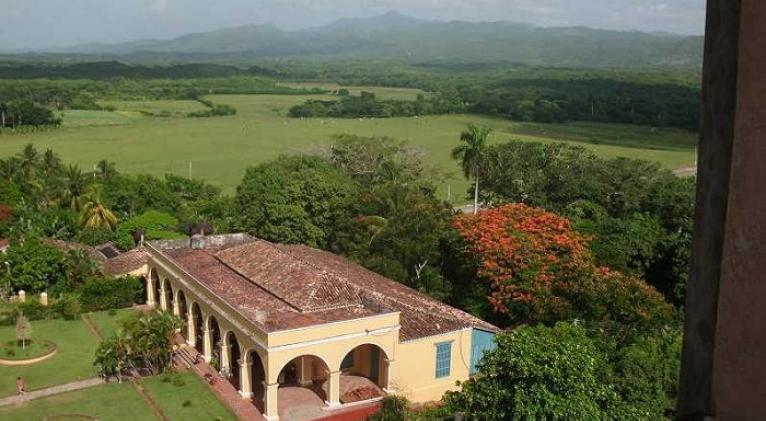
A few kilometers from the city of Trinidad, in the central Cuban province of Sancti Spíritus, stands the dazzling Valley of the Sugar Mills.
Declared a UNESCO World Cultural Heritage Site in 1988, this 110–caballería site overflows with beauty, renown, relics, and legends.
With a history of economic opulence, its fertile lands for sugarcane production stretch out protected by mountains, plains, and the Agabama River, discreet guardians of its natural landscapes.
Some of the estates and architectural remains are still there. In the distance lies the coastal strip whose waters once carried ships laden with their sweet cargo of sugar to destinations around the world.
Behind remains the city of Trinidad, with its well–preserved colonial architecture that seems untouched by the passage of time. Mansions and palaces owe their grandeur to the wealth extracted from the cane plantations and pressed in more than 70 sugar mills that dotted the Valley.
The prosperity of the sugar industry was such that it generated solid capital and profound economic, social, and cultural changes for nearby Trinidad. Founded in 1514 by adelantado Diego Velázquez, and the third settlement established on the island, the city ranked among the most flourishing in Cuba.
Such was the bounty drawn from the Valley’s sugar industry that it fueled urban projects in Trinidad. This phenomenon extended from the 18th century to the mid–19th century.
San Luis was the name by which the Valley was known long before it achieved glory as a center of fortunes. The suitability of those lands for cultivating the grass sparked the ambitions of many landowners.
Thus, in those areas multiplied not only small and large mills, but also stately homes, palaces, and slave quarters for cutting and processing cane.
In the midst of the clamor of cane mills, estates, and capital, the Valley of the Sugar Mills saw the emergence of another heritage, this one bathing the popular imagination in gold.
Legends and superstitions seeped through the mills, grew with the aroma of sugar, and crossed thresholds to sweeten or… embitter, both owners and workers, rich and poor alike.
No one remembers when or why, only that many years ago a wealthy landowner named Don José Mariano Borrel, owner of the Guáimaro mill, made a pact with the Devil, after which he hired an Italian artist to paint the satanic figure on a wall of his home.
It is said that the perfection of the image made it appear so real that it terrified those who looked at it. So much so that even the owner’s own relatives refused to enter the room. People claim that strange noises could be heard there at night and that even in total darkness the drawing could be seen.
Decades later, after Borrel’s death, his heirs tried to cover the wall with lime repeatedly, yet each time the image reappeared, defying human fears and suggestions.
Some testify that it is merely legend, one of hundreds that pass from mouth to mouth and slip among dirt roads, walls, streets, homes, and ruins of the city of Trinidad and its Valley of the Sugar Mills.
The Guáimaro estate, built around 1788, can be seen atop a small rise. The imposing residence has survived over the centuries against time and tempests, neglect, and restorations.
A few steps lead to the continuous open porch that dominates its façade. From that height, the view of the Valley is absolute and, even today, paradisiacal. Perhaps its owner considered these and other details when he ordered the mansion built.
A double–leaf door leads to a space containing three bedrooms, a study, a parlor, and, of course, living room, dining room, kitchen, bathrooms, as well as an oratory or chapel where masses were celebrated.
On the walls of several rooms stand out valuable murals by the renowned Italian painter Daniel Dall Aglio. These works, completed in 1859, along with the house and the archaeological remains of the former mill, underwent complex restoration work. Today the house functions as one of the Valley’s museums.
A stirring breeze rises from the Valley of the Sugar Mills up to the Guáimaro estate. The creak of boots and the dry snap of a whip unsettle the imagination and disturb even the most convinced tranquility.
Without a doubt, this architectural jewel preserves a life that, despite the passing years, retains its aura of secrets and vanities, intrigues and legends. A spirit of undeniable passions that still manages to ignite local fantasies and superstitions.
Translated by Sergio A. Paneque Díaz / CubaSí Translation Staff














Add new comment