
 English
 Español
Russian Ark
especiales

Russian Ark (Aleksandr Sokurov, 2002) amazes with its ability to transcend the technical proposal—innovative and challenging—to establish a lyrical universe, a powerful metaphor. The feat of having been filmed in a single sequence shot is barely the surface of a work that delves into the consciousness of a nation: Russia.
Sokurov isn't content with formal virtuosity: he uses the camera as an extension of memory, as an instrument to reflect on art, history, and identity. Visual continuity is spiritual continuity.
Dreamlike and rational—dreaminess and analysis merge without conflict—the film highlights, without excessive ado, the milestones of a people's history and culture. It’s a marriage of fascination and melancholy: artistic splendor coexists with tragedy, without idealization or condemnation. Sokurov achieves that rare alchemy between the real and the imagined; the viewer does not attend a conventional history lesson, but rather a sensorial and reflective experience.
The Russian Ark speaks to the density and volatility of time, its meanders and cascades. Each room of the Hermitage, each corridor, is a fold in time, a transition between eras that merge and blur. The camera navigates a river of images that never stops, revealing the hypnotic presence of the past in the present.
This fluidity assumes the museum as an organism: a realm of anatomical tensions.
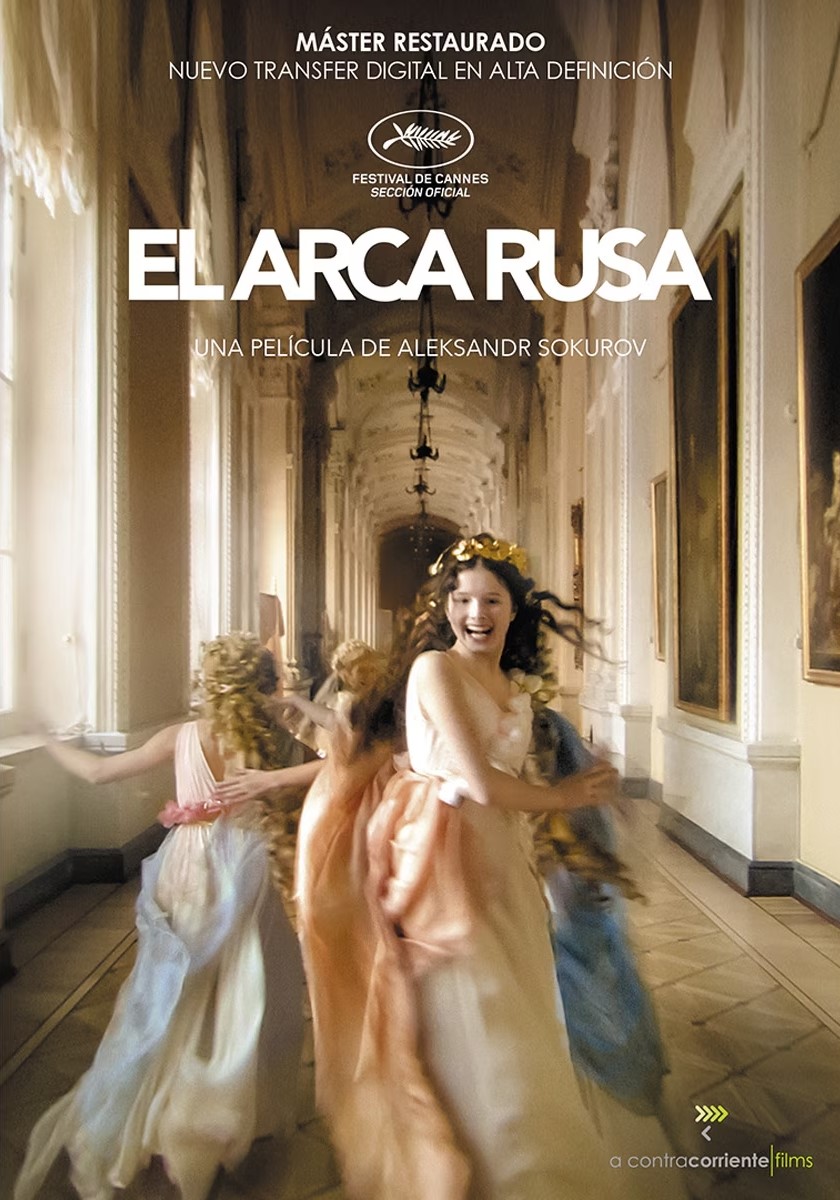
The title is an extraordinary fit. In an ark, everything is intertwined, but it is possible to discern the unifying spirit of the whole. The Hermitage presents itself as an ark of Russian culture—and, by extension, of humanity—where beauty and memory survive the shipwrecks of time. There, emperors and artists, saints and courtiers, ruins and hopes coexist. Sokurov proposes art as a refuge and, at the same time, as a question: what is truly saved when everything changes?
The film unfolds, in its single take, like a roller coaster. Perhaps at first it is dazzling, but once the feeling of vertigo has passed, it channels itself into irreversibility. The leaps in time are, in any case, the contribution of imagination and poetry, humankind's ability to recreate circumstances and give meaning to the chaos of history.
Russian Ark reaffirms a great aspiration of cinema: to be simultaneously thought and emotion, dream and testimony, a realm where the fleeting and the eternal intertwine: a marvelous simulation of life.
THE SYNOPSIS
Russian Ark is a hypnotic journey through three centuries of Russian history and culture, narrated in a single, uninterrupted sequence shot inside the Hermitage Museum in St. Petersburg. An invisible narrator and a 19th-century French diplomat walk through the museum's halls, encountering characters, eras, and symbols that intertwine in a reflection on memory, art, and national identity. Aleksandr Sokurov transforms this journey into a poetic and visual experience where time folds upon itself and the past revives with the power of a lucid dream.
THE FILE
Original Title: Russkiy kovcheg
Director: Aleksandr Sokurov
Screenplay: Aleksandr Sokurov
Photography: Tilman Büttner
Music: Sergei Prokofiev, Georgy Sviridov, and other classical composers
Production: Hermitage Bridge Studio / Egoli Tossell Film / Telefilm Canada
Country: Russia
Running Time: 96 minutes
Format: Single sequence shot, filmed in high definition (HD) at the Hermitage Museum, St. Petersburg
Cast: Sergey Dontsov (Marquis of Custine), Leonid Mozgovoy (narrator) Hundreds of actors and extras
Premiere: 2002 (Cannes Film Festival)
AVAILABLE ON YOUTUBE: https://youtu.be/cAdngeArvrk?si=pdcZZKHs0fNcW4fY
Translated by Amilkal Labañino / CubaSí Translation Staff







Add new comment