
 English
 Español
The Maradona Myth: Five Years After His Death
especiales

This November 25th marks five years since the death of Diego Armando Maradona, one of the greatest soccer players of all time.
The poor boy born in Villa Fiorito, the son of Diego and Doña Tota who put the world at his feet, achieved immortality. Diego, or simply Maradona, was elevated to the status of a myth long before his death.
From his emergence at Argentinos Juniors, he showed his genius quality. He was even on the verge of being crowned world champion in the tournament hosted by his country in 1978, but César Luis Menotti decided not to rush him. A year later, he redeemed himself in the youth World Cup in Japan.
The 1986 World Cup in Mexico was all that was needed to immortalize him. Maradona was the tournament's great figure and delivered the second World Cup trophy to his country. His two goals in the quarter-final against England would go down in history as Argentina's redemption following the Falklands War that had occurred a few years earlier. The mythical Hand of God, and what many experts consider the greatest goal in World Cup history, remain etched in the retinas of those who witnessed those pivotal moments in the tournament's history.
Argentina's second World Cup had one name: Diego Armando Maradona. Four years later, he would lead Argentina to another World Cup final, though he could not win it.
In 1994, he was expelled from the U.S. World Cup due to a doping violation, leaving a final, sad image. Although Diego would return to the Albiceleste bench in South Africa 2010, leading the team to the quarter-finals.
The God of Naples and the People
He played for important clubs, but none like Napoli. There, he was elevated to the category of a God. For this reason, the San Paolo stadium was renamed in his honor, and his presence is perennial in the Italian city.
With the southern Italian club, he won two Serie A titles (1987 and 1990) and a UEFA Cup, the institution's only international title, plus an Italian Cup. In 1987, he won the Scudetto and Cup double, a feat only previously achieved by three Italian giants: Torino, Juventus, and Inter. Seven years were enough for him to mark the club's history as the greatest footballer ever to set foot on Neapolitan soil.
Although Diego is idolized in Boca, Barcelona, Sevilla, and throughout the world, because with Maradona there were no half-measures: you either loved him or you hated him.
Always on the Side of the Humble
Diego was always on the side of the humble. Perhaps that is also why he passed into eternity as the people's Diego.
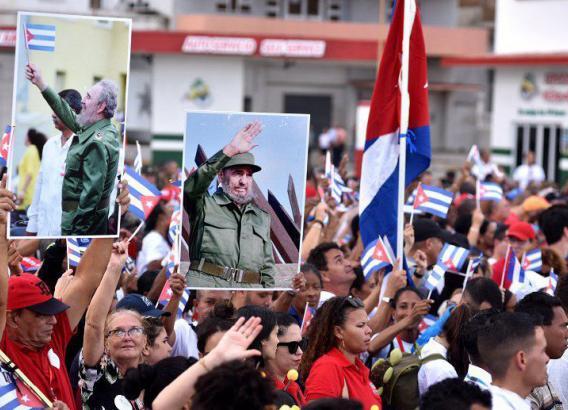
He maintained a strong friendship with progressive leaders in Latin America. Fidel Castro was his great friend, and Cuba sheltered him when he needed it most. This is why an image of Fidel was tattooed on his leg. History would have it that they both died on the same day: November 25th, four years apart.
The Maradona myth departed early at just 60 years of age, but we are left with his passion for the ball, his belief that "la pelota no se mancha" (the ball is not stained). We are left with his social commitment. And it does not matter if five, ten, or a hundred years pass: the Maradona myth will transcend time.






Add new comment