
 English
 Español
Venezuela Is Not Alone
especiales

When the supposed greatness of a nation lies in its brute force, in its capacity to subjugate other nations and make them serve as a platform; when, in the 21st century, social Darwinism is brandished as the basis of international relations, and the extrajudicial execution of 83 people in the Caribbean Sea is considered a “valid” warning; when the ethnic cleansing of a territory with the intention of repopulating it's justified or ignored, humanity becomes dehumanized, regressing to the primary stages of its evolution. And if at the head of one of these primitive armies—which do not fight hand-to-hand, nor employ spears or axes, but rather drones and “smart” missiles, and which, by virtue of their technological development and the wealth they have plundered from other peoples, reserve the right to own weapons of mass destruction—is a haughty and overbearing petty king who sees himself as invincible, human civilization wobbles on the brink of cataclysm.
But there are nations whose defining characteristic is not the conquest of territories, but the capacity to defend their own and contribute to the emancipation of others; seemingly weaker nations that liberated the entire southern part of the American continent from Spanish colonialism in the 19th century, or contributed decisively to the independence of Africa in the 20th, whose concept of strength is not associated with the number or the lethal capacity of their weaponry, but with the moral strength of their people. There are names that symbolize them: Bolívar, Martí, Sandino, Fidel, Ho Chi Minh, Chávez. Primitive armies and petty kings are unaware of this other kind of force; they don't see it, they don't understand it, and this cognitive blindness drives them to repeat the same mistake over and over again.
The petty king gazes at himself each morning in the mirror of his vanity. He has amassed an unprecedented naval force off the coast of Venezuela, the homeland of Bolívar, of Our America. Will I succeed? Will I fail? Those who will not fight whisper in his ear: You can… And there are always lackeys calling for armed intervention in their native land. He curls his lips, raises his chin like Mussolini, pretends to see the future. But he cannot see; he only sees himself. He will try to obtain some concession in exchange for not attacking. We denounce, we demand the immediate withdrawal of this primitive army that celebrates death and seeks to subjugate another people in order to seize their riches! Venezuelans know their history; they are not afraid. The threat of war has only strengthened their bond. But Venezuela is not alone. With her are all the peoples of the Greater Homeland, even though some cowardly and foolish leaders believe that by allying themselves with the invader, they secure their petty, selfish interests. They don’t know that the only interest that counts in an act of force is that of the one who wields it. These are the two poles of history: life or death, dignity or submission, solidarity or betrayal. In today's terms: socialism or barbarism. José Martí warned Latin Americans in 1891, when the imperialism he had witnessed was rearing its ugly head: “The trees must stand in a row so that the seven-league giant cannot pass! It’s the hour of reckoning, and of marching together, and we must walk in close formation, like the veins of silver in the roots of Los Andes.”
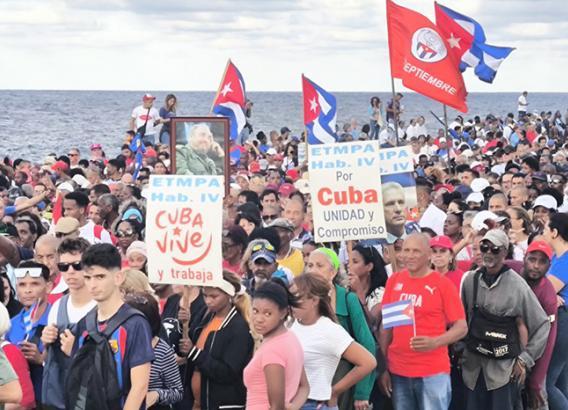
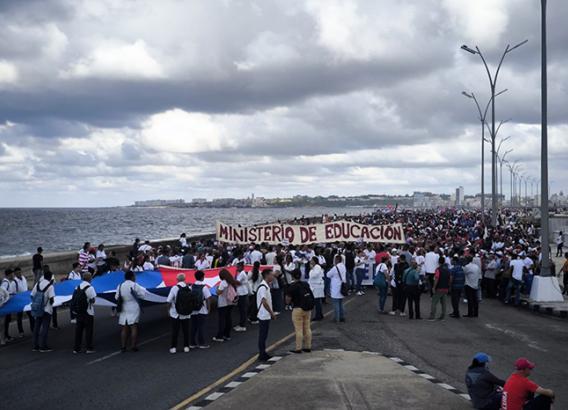
There are no conquests or episodes of plunder of which any human being can be proud. In the 21st century, honor is bestowed by a spirit of solidarity. Those who give without expecting anything in return, receive it. Cuba and Venezuela, sisters in peace and, if necessary, in war, lavish it. We are not alone.
Translated by Sergio A. Paneque Díaz / CubaSí Translation Staff





Add new comment