
The Struggle for Cuba Does Not Cease: It Is Maintained and Intensified
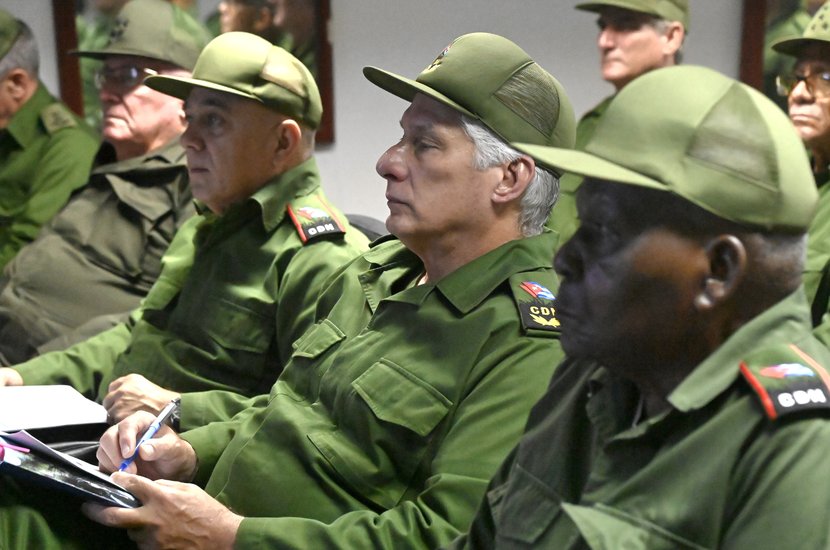
Miguel Díaz-Canel Bermúdez en Día de la Defensa.
Speaking of a great effort, of these months of intense work that have been taking place from the National Defense Council down to the Zone Defense Councils, the President of the National Defense Council, Miguel Díaz-Canel Bermúdez, spoke on Friday morning by way of recognition during his visit to the "Arroyo Arenas" Defense Zone, located in the capital municipality of La Lisa.
The dignitary assessed that this stage, also marked by sacrifice, has "allowed confronting the enemy's maneuvers" and has "allowed addressing in a more direct way, with wartime structures functioning in peacetime, the severe problems that our entire people experience day by day."
In the exchange that took place in the context of the National Day of Defense, Díaz-Canel Bermúdez emphasized that "plans must continue to be refined, work perfected," and stressed the importance of continuing with "direct attention to problems related to food; medicines; water supply; the energy issue; solid waste collection; the fight against corruption; issues of illegality and crime; and above all the application of the Transformations."
Regarding the changes that must occur in the economic and social spheres, the head of state highlighted the importance of the Transformations, in their implementation and application, "providing a response to the population."
The First Secretary of the Central Committee of the Communist Party of Cuba stated: "We are going to hold our ground." Explaining that idea, he said: "We continue maintaining this work system: the structure of the Defense Zones, the municipal and provincial Defense Councils, and the National Defense Council activated full-time; and this is also providing us, in our view, with a group of experiences and important updates to the plans for high defense readiness, which have been adapted to the real conditions we are living."
Regarding the results these months of work are leaving, the President of the National Defense Council noted: "I believe that today you yourselves, as a Defense structure, are better prepared, based on the fact that this has been a training in real time and under real conditions; and that gives the country more invulnerability from the military point of view and from the defense point of view."
Díaz-Canel Bermúdez spoke of linking that strength with ideological invulnerability, and referred to the efforts being deployed, in the context of the Economic and Social Transformations, "to advance toward economic sovereignty."
The spheres of military defense, ideology, and the economy—the president reflected—"will be three elements that will lead us again to a situation of victory in the face of the empire's threats." The head of state asserted: "We remain in combat."
During his intervention, the president insisted that "the threat of aggression against Cuba" is latent and that "it is set out in all that aggressive discourse and elevated rhetoric on the part of the United States Government administration."
Because of that "escalation of sanctions," made "to increasingly besiege our economy," in an act "totally genocidal and totally criminal," the Cuban president spoke about the need to maintain high levels of defense readiness in the interest of the War of the Entire People, "of all the components of the territorial defense system; and that is concretized," he said, "above all in the Defense Zone."
The president's reflections took place after the President of the "Arroyo Arenas" Defense Zone, Rolando Vega Tabares, offered a detailed explanation about a scenario that has more than 15,600 inhabitants and where the activated structures work on tasks that seek to positively impact community life—such as attention to the most vulnerable, the development of health, culture, and food, citizen discipline, and the order and sanitation of each place.
It was a morning that also included the presence of Esteban Lazo Hernández, member of the Political Bureau and President of the National Assembly of People's Power and of the Council of State; the Organization Secretary of the Central Committee of the Communist Party, Roberto Morales Ojeda; the Minister of the Revolutionary Armed Forces (FAR), Army Corps General Álvaro López Miera; Army Corps General and Minister of the Interior Lázaro Alberto Álvarez Casas; and Major General and Secretary of the Council of Ministers José Amado Ricardo Guerra.
Also present were Major General Ernest Feijóo Eiró, chief of the Western Army; the Attorney General of the Republic, Yamila Peña Ojeda; as well as the president of the Havana Provincial Defense Council, Liván Izquierdo Alonso; among other authorities.
Add new comment