
Hermanos Saíz Association, That Space That Allows Dreaming
Asociación Hermanos Saíz, ese espacio que permite soñar
"Socialist construction, which you are also defending, is not only a political, economic, and social process; it is also the dispute over meaning, over feelings, over beauty, over spirituality, and over the symbols that a society as just and inclusive as ours creates; and you, as young creators, are not spectators, you are a sensitive actor participating."
With these words, the First Secretary of the Central Committee of the Party and President of the Republic, Miguel Díaz-Canel Bermúdez, celebrated the permanent creative act in which the members of the Hermanos Saíz Association (AHS) are immersed.
At the commemoration of the 40th anniversary of the organization that brings together the young artistic vanguard, founded on October 18, 1986, Díaz-Canel told them: "Keep creating, keep stimulating that committed creation without renouncing aesthetic experimentation or complexity, because cultural processes are complex and one must also take risks, defend risks, and defend ideas."
The head of state was accompanied by Politburo member and Organization Secretary of the Central Committee, Roberto Morales Ojeda; the head of the Ideological Department and Central Committee member, Yuniaski Crespo Baquero; Vice Prime Minister Inés María Chapman Waugh; the first secretary of the National Committee of the UJC, Meyvis Estévez Echeverría, and other leaders of the Party, State, Government, UNEAC, the branch union, and representatives of cultural institutions.
In the halls of the José Martí Memorial, the First Secretary of the Central Committee of the Communist Party of Cuba held, for nearly two hours, a dialogue with more than fifty AHS members, moderated by the association's national president, journalist and poet Yasel Toledo Garnache, who described an AHS that is and aspires to be "an organization that is useful all the time, far beyond culture."
He spoke of how young writers, artists, intellectuals, and cultural promoters, in addition to carrying out more than a hundred activities of different magnitude in all provinces this period and aiming to grow in creative projects in the different arts, are present in communities, schools, workplaces, and other social spaces.
Víctor Cabrera, a student of Dance Arts and vice president of the AHS chapter at the University of the Arts (ISA), stated that the association has become "the soul" of this higher education center, with the purpose "that the ISA continues to be the creative space it is despite material limitations."
Yeilén Delgado Calvo, a journalist, poet, and mother of two, spoke of how, from the porches of her neighborhood, starting with her own, blackout nights become hours of learning and solace for the youngest, an example she used to argue for the need for art to reach schools and communities in such difficult times with the contribution artists who live there can make.
She proposed promoting that each community mobilize its artists and intellectuals, which sometimes does not require material resources but can change the life, spirituality, and horizon of the children of every place in the country.
On another aspect of how much the integration of artists and intellectuals can contribute in current times, Yeilén analyzed the drastic transformation that has occurred in our audiences' cultural consumption, especially among young people, at the hands of new technologies, and thus advocated greater articulation among AHS members in the areas of social communication.
"We," she noted, "have many valuable young people who maintain podcasts, accounts on different social networks, on Instagram, on YouTube, that are widely viewed, but the algorithm, by its very nature, segments them; so," she reflected, "we must achieve an interrelation, an alliance, between traditional media and their social media platforms, with young people who are opinion leaders, who are influencers, so that we all support each other."
Singer Annie Garcés explained the initiative she has been developing for several years with children from Marianao and which now has as its headquarters the Enrique José Varona municipal library, which is being reborn under an initiative she has begun to lead in the children's and youth area and which will have a concert hall named after troubadour Eduardo Sosa.
She highlighted how the most diverse institutions in the territory, under the leadership of the Party and the municipal Government, often anonymously, are contributing to the revival of the library, an initiative she called for replicating and generating, at the same time, an interaction among all of them, as is already achieved here.
"I believe," she said, "that uniting and losing the fear of knocking on doors will be the best way to move forward, because in the institutions that are in the municipalities, in the neighborhoods, there is a willingness to help. That," she insisted, "is what we have to do: keep uniting, mainly for future generations, who will also be members of the Hermanos Saíz Association."
Manuel Ramírez Heras, director of the news program Haciendo Radio, narrated the artistic, experiential, and revolutionary experience that the making of the ten-chapter historical radio series "Mis muchachos, los Saíz" meant for him, which he wrote and directed, and which is dedicated to the life and work of the Saíz brothers, taking as its center Esther Montes de Oca, mother of the two young poets and revolutionaries murdered by the Batista dictatorship.
It is a deeply patriotic series that the authorial collective and its performers—Ramírez Heras noted—want to bring to schools and universities and leave there as study material, because—he explained—when we are capable of interpreting our heroes in a real, flesh-and-blood way, we can also learn, in this very difficult moment we are living, what the homeland means.
Among the nearly twenty interventions by AHS members at the meeting with the Cuban president was that of Lea Cárdenas, musicologist and singer, who highlighted the importance of being a member of the AHS, "a highly plural space that allows and embraces all kinds of young people with all kinds of ideas, creative capacity, and interests."
The plurality of the Hermanos Saíz Association—she affirmed—is one of its great strengths, "by allowing each of us to inhabit from the ideas we have, from the concerns we have, and to support ourselves in a fairly ecumenical way in everything we want to do. In other words, it is the space that allows dreaming."
CULTURE ALSO CARRIES US FORWARD
In the closing words of the meeting, the Cuban president stressed that, for the work "they are developing," for the support and contribution they are giving, and for the spaces they are creating and leading, the country's young artistic vanguard "has consolidated in all of us a feeling of admiration and respect for what you do."
As has happened in this exchange—he stated—you, in addition to revolutionary commitment, have forged a sentimental, spiritual base of brotherhood, friendship, and cooperation, with a tremendous expression of sensitivity toward the problems we are suffering and facing together as part of our people.
With their joyful and optimistic vision, AHS members—he assured—are also demonstrating "that no matter how hard the times, we as a people have the capacity, with our own talent, with our own work, with our own effort, and with our culture, to move forward."
Addressing the historical legacy of the AHS over these 40 years since its founding and the projection they have defined to face the present times, Díaz-Canel affirmed that the association, without ceasing to be young, is already a mature organization.
After sharing the challenges and risks the Cuban nation faces today from the economic, social, political, ideological, and cultural spheres, Díaz-Canel Bermúdez highlighted the role AHS members can play at a time when hegemonic powers try to culturally colonize peoples.
But we—he emphasized—"cannot allow our culture to be colonized, which is why we must defend culture, culture in its broadest expression." Therefore—he expressed—the association's response in these times, as you have expressed here, "is proactive, educational, against tackiness, against vulgarity, against anti-values, and it must reach audiences with much emotion, much feeling, much passion, and particularly the young Cuban audience, defending autochthonous cultural products with quality and symbolic power."
MAESTROS DE JUVENTUDES AWARD CEREMONY
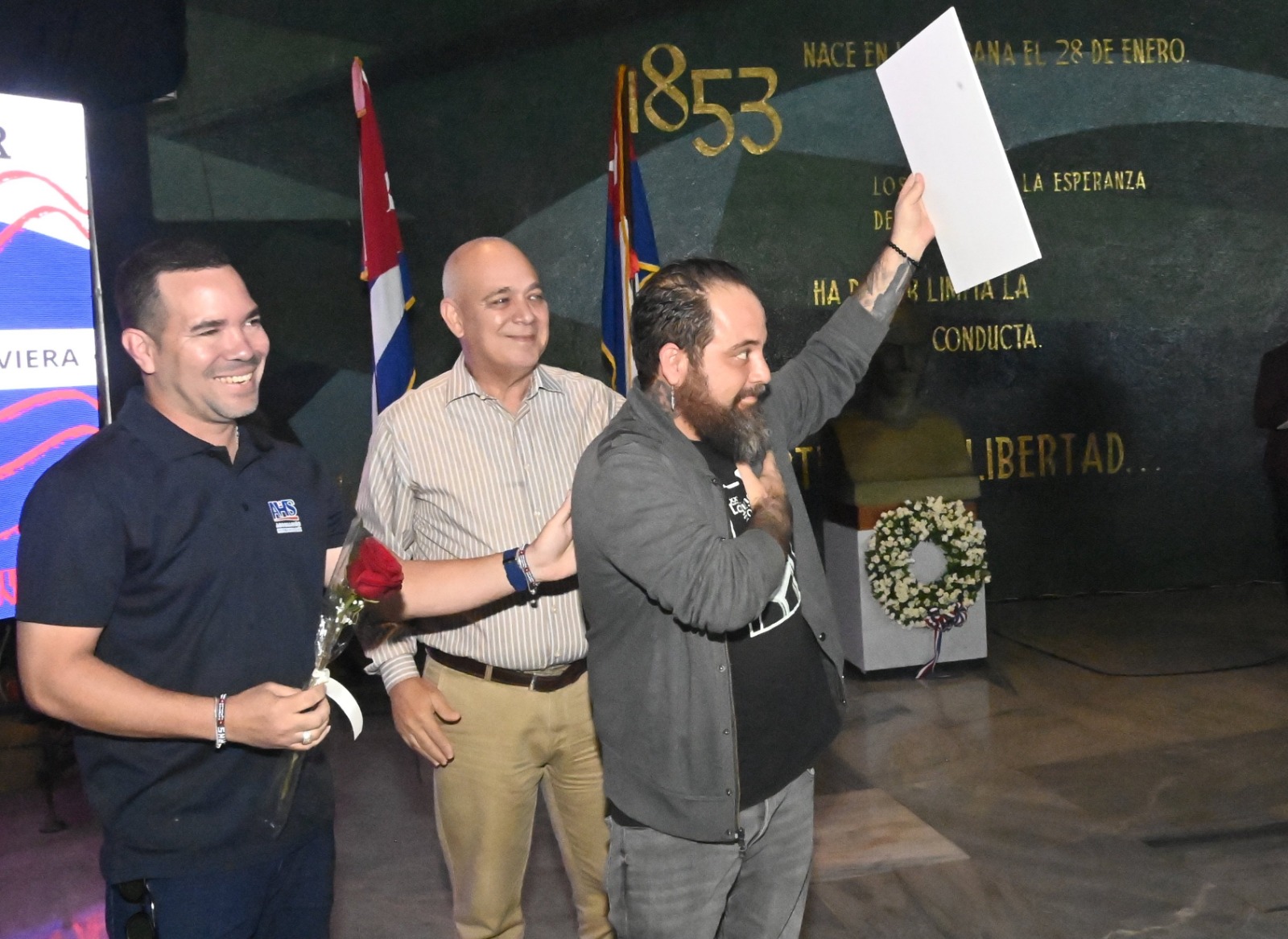
During the day, the First Secretary of the Central Committee of the Party and President of the Republic, Miguel Díaz-Canel Bermúdez, also presided over the presentation of the Maestros de Juventudes Award to nearly twenty personalities.
For their status as valuable exponents of our culture, who with their creation and teaching have defended committed and revolutionary art, from the hands of Miguel Díaz-Canel Bermúdez and Yasel Toledo Garnache they received the distinction granted by the Hermanos Saíz Association: Regina Balaguer Sánchez, Marilyn Bobes, Mirtha Ibarra Collado, María Elena Vinueza, Josefa Bracero Torres, Marta Anido Gómez Lubián, José Ramón Artigas Vázquez, Jorge Fornet, Josué Oliva, and Orlando Cruzata.
The award was also granted to Moisés Finalé, Liuba María Hevia, Luis Carlos Suárez, Lucía Muñoz, Rodulfo Vaillant García, and Dagoberto Gaínza. Brazilian writer and social activist Frei Betto was also distinguished.
At the commemorative event for the AHS's 40th anniversary, other Cuban artists and intellectuals were also awarded the status of Honorary Members of the organization, the Replica of the Monument to the Saíz Brothers, the Alma AHS status, and the 40th Anniversary Seal of the Hermanos Saíz Association.
Add new comment