
Cuba with Its Heart in the Center of Its Chest
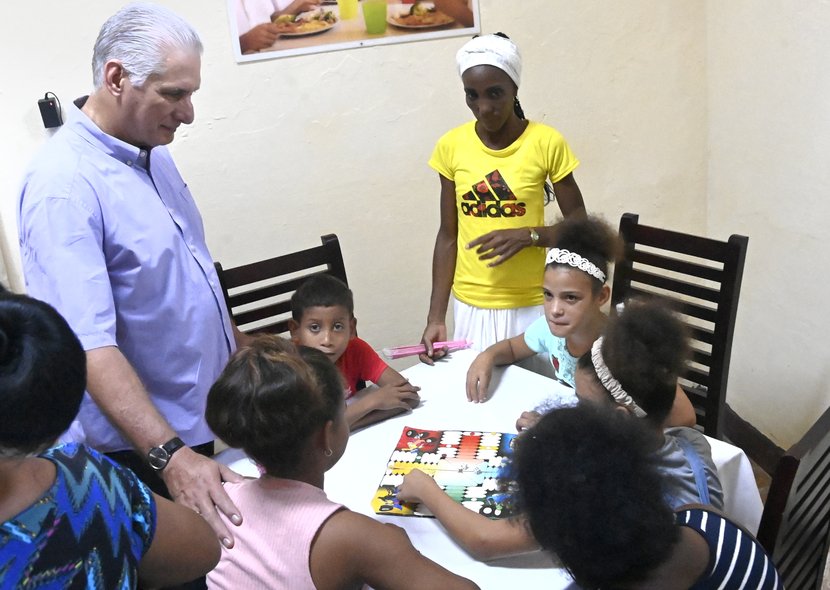
Foto: Estudios Revolución
This Wednesday morning, as President Díaz-Canel toured the "Víbora" Popular Council in the Havana municipality of Diez de Octubre, a truth remained standing while cribs, tables, chairs, toys, and new backpacks—awaiting their debut in the new school year—could be seen: Revolutionary Cuba does not abandon a single one of its children.
In Cuba, nearly 1.5 million children and adolescents will attend classrooms when the new general education school year begins on September 1. This was reported Wednesday morning by Education Minister Naima Ariatne Trujillo Barreto to the press team of the Presidency of the Republic of Cuba.
The minister's statements took place at the "Cepero Bonilla" Primary School, located in the "Víbora" Popular Council in the Havana municipality of Diez de Octubre, following a visit to that educational institution by the First Secretary of the Communist Party of Cuba Central Committee and President of the Republic, Miguel Díaz-Canel Bermúdez.
"The school year begins on the first; in fact, it has already begun, because our workers have been back since this week," the minister told reporters, noting that many professionals "have not had much vacation, trying, as we teachers always do, to condition the facilities as best as possible."
At each educational institution, she stated, there will be a welcome for new students, their families, and continuing students. Naima emphasized that the new school year—conceived, she said, so that "all social and economic actors get involved"—will carry "a great deal of flexibility, much individualized response," without neglecting the institutional and group project.
In the current circumstances, she reflected, "the response of each educational level, of each institution, of each territory, of each group, and of each child and adolescent" will require "a level of differentiation" that includes "many variations."
Along the same line of reasoning, she detailed that "there will be double sessions, with certain characteristics where possible" and that, "to complement educational life, there will be other programs with youth, neighborhood, and professional participation; because you may have classes in the morning with your group, and then there is something that complements the learning with an innovation project."
Among the innovative projects, the minister mentioned, by way of example, interaction with university students passionate about computing and Artificial Intelligence, or with others who enjoy singing or sports: "That is, we are trying to ensure there can be a complementary life, but in each place decisions must be made in correspondence with the conditions at hand."
Naima shared the observation that, following a tour across the island, "we saw our professionals very committed at all levels," as well as other forces and actors present in all settings. She emphasized the value of "a response that is not only for the beginning of this teaching stage but can be made sustainable."
"Now we have to evaluate everything, now we have to be very rigorous in follow-up," she said, alluding to students who are farther from institutions and for that reason receive more specific and complex responses.
No Child Without Protection
Wednesday morning prompted reflections and emotions as the Head of State toured the area where the "Cepero Bonilla" Primary School is located—a Popular Council that also has Children's Homes without Parental Care and an Urgent Shelter Center, a mode of care born from the recent Children, Adolescents, and Youth Code.
Díaz-Canel's tour—accompanied by Vice Prime Minister Eduardo Martínez Díaz, the Education Minister, and other officials—had as its first stop the "Víbora II" Home for children, adolescents, and young people without parental care.
There, the Head of State took interest in how the children's lives unfold; how economic actors coordinate with the home's operation; and how the educational and vacation moments of the children and adolescents are spent.
Nearby, the next place visited was the "Víbora I" Infant Home. There, the president asked about the children. And about those who work there—about ten—he expressed that the people who carry out their work there "have their hearts in the center of their chests." He said this because it takes great sensitivity and purity of soul to protect the lives of beings so defenseless and in need of love.
Then, on the itinerary, it was the turn of the "Cepero Bonilla" school. Finally, the Cuban president arrived at the Urgent Shelter Home, a space designed so that children, adolescents, or young people in situations of extreme vulnerability can be quickly protected while specialists define a differentiated care strategy.
From that new Shelter space—a kind of transit point—minors can go to a Home, to a family, or to a loved one who decides to assume parental responsibility. For all minors, the new school year and the value of learning represent a common fortune.
This Wednesday morning, as Díaz-Canel toured the "Víbora" Popular Council in the Havana municipality of Diez de Octubre, where there is more than one vital institution for human dignity, a truth remained standing while cribs, tables, chairs, toys, and new backpacks—awaiting their debut in the new school year—could be seen: Revolutionary Cuba does not abandon a single one of its children.
Add new comment