
To Cuba, on behalf of Colombia
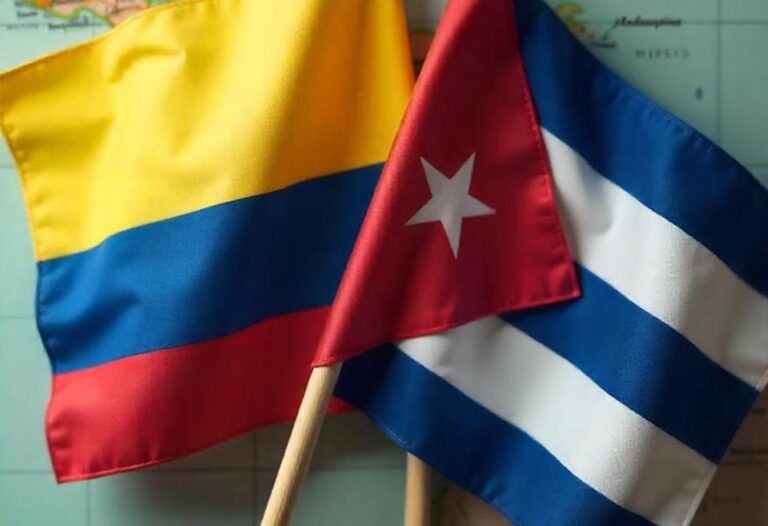
Only Cuba's generosity is greater than its history. With the world, with today's Global South (which does exist, despite efforts to convince us it is an empty abstraction), with Latin America, and with Colombia. No state in Latin America and the Caribbean has been more aggressively targeted in contemporary times, yet it has always responded by building bridges, providing aid, and joining the most just causes.
Without a single minute having passed in this new administration, already in office, the closure of the embassy in Havana was announced, citing reasons that have nothing to do with our diplomatic tradition and threatening its sovereignty. Colombia does not have the authority to qualify its political system; if that were the case, at various points in our history the world would have had to break all ties with our country. Havana has been a friend to peace processes, present in all those with international participation. Fidel Castro was a staunch defender of a negotiated solution, and when asked for humanitarian gestures, he provided interlocution without hesitation. The most significant peace agreement bears the name of its capital—this is not an anecdotal fact, but a reflection of that commitment that has moved from words to actions.
The only blemish occurred during the government of Julio César Turbay Ayala, when Cold War logic led us to a position of international submission with a domestic facet expressed in the Security Statute, which led to levels of repression that had nothing to envy from the military dictatorships of the Southern Cone. Persecution, torture, and exile were the norm. Is the government of De la Espriella and his chancellor Bula Escobar perhaps mirroring that endemic authoritarianism? As Sandra Borda rightly pointed out—whom no one can accuse of being in the ranks of communism—not a single press conference, interview, explanation, or transparent justification for such a decision has been offered. No one understands how, having reached this point, there are no voices in the government stepping forward while years of work are dismantled—not only from the Petro and Francia Márquez administration but from decades, including those of right-wing figures like Andrés Pastrana and Álvaro Uribe, who maintained friendly dialogue with Havana. In one of the worst moments of tension between Uribe and Chávez in 2005 over the capture of Rodrigo Granda in Caracas, when no way out seemed possible, Castro himself, at Uribe's request, intervened to ease positions and find a starting point for a solution. The former Colombian president acknowledges this in No hay causa perdida.
Pettiness cannot be the course of our foreign policy. Its extreme ideologization is concerning, as is the transfer of internal disputes to the international stage—worse still, interference in internal affairs with qualifiers or judgments that do not correspond to Colombia. As Andrés Manuel López Obrador said regarding the crude policy of interference toward Cuba and Venezuela: "We cannot be a streetlight on the street and darkness at home." Cuba is experiencing, due to the embargo or blockade—undeniably illegal—one of the most critical moments in its history. The collective punishment through externally caused shortages has no justification; Colombia must not participate in such aggression.
That Cuba, which they arbitrarily label a dictatorship, punishing it for having adopted the path of a people's democracy, we must defend—not exclusively from an ideological standpoint (everything is steeped in ideology, as Slavoj Žižek rightly says)—but by remembering the inescapable responsibilities of state, the commitment to international law, and our historical position of condemning the embargo. It is never too late to do the right thing.
*Professor at Universidad del Rosario
Translated by Sergio A. Paneque Díaz / CubaSí Translation Staff
Add new comment