
Rodrigo Chaves: The Great Costa Rican Charlatan
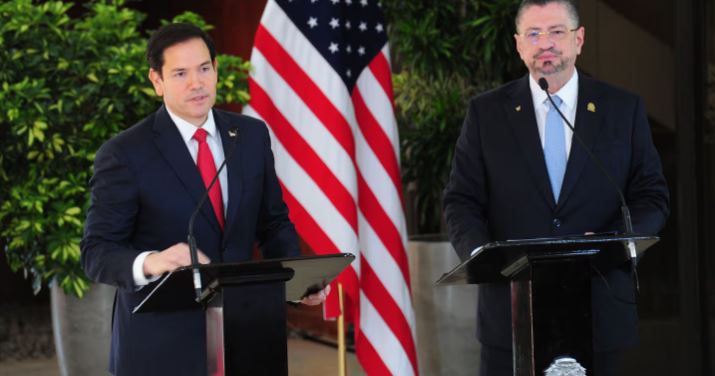
Following the same script as Noboa in Ecuador, the current president of Costa Rica, Rodrigo Chaves, abstained at the United Nations on the rejection of the United States' blockade policy toward Cuba, and then expelled Cuban diplomats from San José, launching incoherent attacks against communism and firmly adhering to the strengthened policy of suffocation implemented by his idol, the genocidal Donald Trump.
It's hardly groundbreaking to point out that he is a meticulous follower of Trump and his directives to hand over national wealth to American companies.
In this context, his defense of the American magnate's decision to send federal agents to lead the national police in combating rising crime is scandalous.
Chaves had a somewhat murky past, linked to sexual advances during his time at the World Bank, which led to his dismissal, although documents containing allegedly lurid accounts have disappeared.
In short, a complete Trump-esque monstrosity, prepared in this context since 2022, which led one opponent to declare that “he seems more like an American congressman than our president. Now the White House is calling the shots. Out of fear of losing his visa. He's afraid of the Devil, the hotel owners, the bus drivers, and even Pilar (a congresswoman) herself.”
I LOVE MY DAD
The decision by Rodrigo Chaves—referred to in public discourse as “Chévez”—a figure of ridicule—to break diplomatic relations with Cuba has generated strong controversy in Latin America, not only for its political implications, but also for the message of alignment it conveys in the current geopolitical context.
From a critical perspective, this measure does not reflect a sovereign foreign policy or an independent state strategy, but rather a position of subordination to the interests of Washington, particularly to the influence of US President Donald Trump, whose hard line against Cuba has been replicated by various governments in the region.
The break has also been interpreted as a gesture of ingratitude toward the Cuban government, especially considering its history of cooperation in health matters. For years, Cuban medical brigades have provided support to Latin American countries in critical moments, including health emergencies and areas with limited access to medical services. This history makes the decision even more controversial in ethical and diplomatic terms.
This move highlights a worrying trend in some Latin American governments: the abandonment of independent foreign policies in favor of external ideological alignments. In this context, Chávez has been the subject of criticism, not only for this decision but also for previous statements in international organizations, which fuels questions about the legitimacy and motivations of his actions.
Following the example of his counterparts in other parts of the world, since May 8, Since 2022, Chaves has literally been dismantling the very political institutions he swore to defend, forging dangerous alliances for the country's future, some overt, others surreptitious.
His direct confrontations with the Judiciary, the Supreme Electoral Tribunal, the Legislative Assembly, and the Comptroller General's Office have a clear objective: to weaken Costa Rican institutions in order to perpetuate his hold on power, either through reelection or by replacing his cronies, or rather, his pawns. As former journalist and current congresswoman Pilar Cisneros admitted in a radio interview, the criticism that he and his supporters intend a dictatorship is false, but "if the people so desire at the ballot box," who are they to disregard the mandate of the "sovereign"—a word Cisneros has used to manipulate and maliciously abuse.
The bloodbath gripping the country seems to matter little, if at all, to the legislative faction still loyal to Chaves, his ministers, or the head of the Executive Branch himself: in just the first month of the year, more than 100 cold-blooded murders have occurred, many of them innocent victims of clashes between drug trafficking organizations operating in every neighborhood across the nation.
The only concern of Chaves and his acolytes is to perpetuate their hold on power at all costs, even if it means bloodshed and terror for citizens amid the rampant insecurity faced by Costa Ricans—a price they are unwilling to pay in exchange for their lust for power.
Opposition members have conceded that if Chaves had at least dedicated some time to solving national problems, he might have been given some credit, but this is not the case.
In terms of infrastructure, the government has limited itself to inaugurating half-finished projects that were already underway under previous administrations. It doesn't care about making a fool of itself by celebrating the installation of modular or Bailey bridges. It has brought the public health system to the point where people die waiting for simple medical procedures due to a lack of specialists, equipment, or hospitals. Education is adrift without a clear direction, let alone a path toward educational improvement, and the cost of living hasn't decreased one bit.
The government continues to manipulate economic indicators and fails to make the legally mandated transfers to present positive macroeconomic figures and low inflation, which only benefits certain importing industries. And to make matters worse, it appropriates the achievements of previous administrations with grand announcements and contrived displays.
A FALSE MESSIAH
The recent letter from Margaret Satterthwaite, United Nations Special Rapporteur on the Independence of Judges and Lawyers, sent to the Costa Rican government, points to a clear campaign of harassment against the judiciary. This observation joins the international chorus of condemnation regarding the growing erosion of freedom of expression and of the press, which stigmatizes and intimidates critical journalism through direct attacks on journalists, the manipulation of advertising spending to reward some media outlets and punish others, and, deeply concerning, the publication on social media of the personal and private information of journalists and activists, which exposes them to risks and potential attacks.
While all this is happening, Chávez continues to play the 21st-century Messiah, deliberately inciting civil unrest, which will sooner rather than later lead to direct attacks on his political "enemies"—journalists, judges and magistrates of the Republic, members of parliament, and others—by the small groups that persistently call on social media to take up arms to defend his political agenda, without him doing anything to prevent it; in fact, he encourages it.
Their posturing sometimes mimics that of Milei and Noboa, charlatans incapable of accepting criticism maturely, to which they react disproportionately in an emotional and defensive manner, assuming the role of victims of the system. Criticism is considered treason because they need to be recognized as divinely ordained emissaries to feel legitimized, and thus go down in history as those awaited by the masses, who in the Costa Rican case harbor a potential authoritarianism, feeling protected by the occupant of the White House.
A seasoned journalist describes the current situation as that of a state “hijacked by a great charlatan who, over the course of three years, has demonstrated incompetence and lacks the emotional skills to maturely accept criticism, much less to sit down at the table to build a solution to the challenges we face. Rodrigo Chaves Robles, without a doubt, you are a great charlatan.”
Translated by Amilkal Labañino / Cubasi Translation Staff
Add new comment