
Donald Trump: Mocking the American People
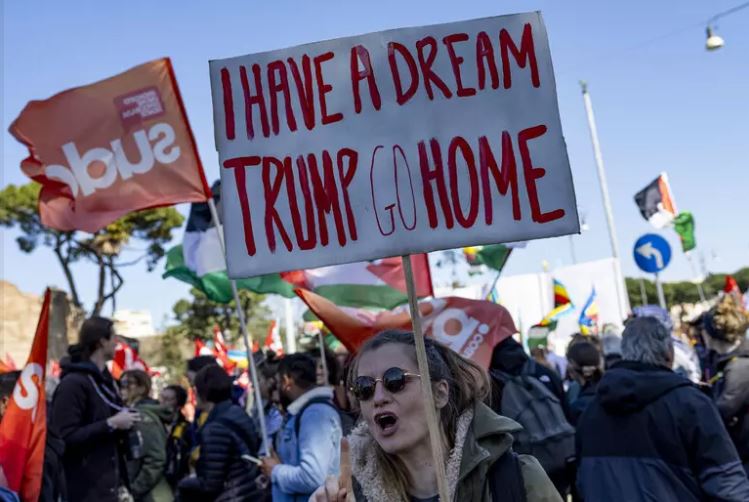
Protestas No Kings en Roma. Foto ANSA
"We already fought this war before; we already fought against these Nazi people; we already exposed them before. And the fact that so many people remain so blind to the fact that this man [Donald Trump] is doing exactly the same thing… it’s as if no one has read history. Nuremberg was something powerful."
The history of the United States is filled with poor leadership—this is hardly debatable. Yet many argue that Donald Trump stands among the worst to have occupied the White House, as reflected in his low approval ratings, sustained largely by a base described by critics as misinformed or influenced by propaganda.
It is therefore unsurprising that, in an unprecedented and rapidly organized response, millions of Americans from diverse social backgrounds—not only the most vulnerable—have taken to the streets across the country. They protest what they see as deception by an administration that barely conceals its militaristic tendencies and disregard for human life.
While Trump insists that the economy is performing well, many American families are increasingly struggling to make ends meet.
On immigration, large segments of immigrant communities—whose labor has contributed significantly to the economy—live in fear of detention and deportation by Immigration and Customs Enforcement (ICE). Meanwhile, American society remains deeply divided, with some citizens showing solidarity and others demanding swift deportations.
Regarding Trump’s pledge to avoid foreign wars, critics argue that he has broken that promise, endangering not only national security but global stability.
According to the Associated Press, millions have marched nationwide to remind the president that, although he represents the country internationally, not all Americans support his policies. These demonstrations also serve as a warning ahead of the upcoming November elections, where voters will determine the future direction of his administration and the Republican Party.
Organizers estimated turnout at five million participants in June and seven million in October, with expectations reaching ten million. The scale of participation reflects the national mood during a time marked by escalating conflict, particularly a war involving Iran with unpredictable consequences.
Nuremberg
"I’m really looking forward to seeing you in Nuremberg!" read a sign carried by Christina Morales of Pasadena. It displayed images of President Trump, Vice President Vance, Defense Secretary Pete Hegseth, Secretary of State Marco Rubio, and former Homeland Security Secretary Kristi Noem.
"We already fought this war before… Nuremberg was something powerful."
The Nuremberg Trials (1945–1949) were a series of international military tribunals established by Allied powers after World War II to prosecute Nazi leaders for crimes against peace, war crimes, crimes against humanity, and conspiracy. They set a lasting precedent in international law.
Outside Pasadena City Hall, Representative Judy Chu criticized Trump for spending $25 billion on the war in Iran while neglecting domestic priorities such as healthcare, child nutrition, and veterans’ support.
"He is willing to waste billions on Tomahawk missiles to kill people, but not a single cent to keep Americans healthy," she stated. "He will fund a war machine abroad but refuses to invest in feeding our children, supporting our veterans, and educating our students."
She added that Americans are being crushed by soaring costs in food, fuel, and healthcare, accusing Trump of seeking global dominance while requesting an additional $200 billion in military funding.
Even media outlets not typically critical of Trump have acknowledged the scale and intensity of the protests, describing the administration’s power as overwhelming.
A Time of Monsters
Mauni Jalali, a constitutional lawyer, highlighted what he described as global injustices under Trump’s leadership, including ongoing conflicts in Palestine, Gaza, Lebanon, and Iran.
"This is a time of monsters. We have monsters in Palestine. We have a genocide across Gaza. We have Trump’s so-called ‘peace plan.’ We have permanent occupation, permanent apartheid," he declared.
"This is a very difficult moment in the West Bank. There is ongoing ethnic cleansing in Lebanon; civilians are being bombed across the south. And all of it is funded by our tax dollars and without our consent."
He further argued that the war against Iran is illegal under both U.S. law and international law.
"Any president must go to Congress. He did not. No president can go to war unless authorized by the United Nations Security Council; they did not. This is a war of aggression—the ‘supreme international crime,’ as defined by the Nuremberg judges."
These demonstrations, far from being symbolic, reflect widespread dissatisfaction and serve as a warning that voters may hold the administration accountable in upcoming elections.
What Trump Said
"I don’t want wars. I want fewer wars than almost anyone. Peace through strength," Trump stated during a press briefing.
He defended U.S. strikes on Iran, arguing that "we would have had a nuclear war that could have turned into World War III, and more importantly, there would have been nothing left."
He also claimed that the conflict is nearing its end, stating that "there is nothing left to attack" and that the United States is prevailing.
Translated by Sergio A. Paneque Díaz / CubaSí Translation Staff
Add new comment