
Fernando Hechavarría's Celebration
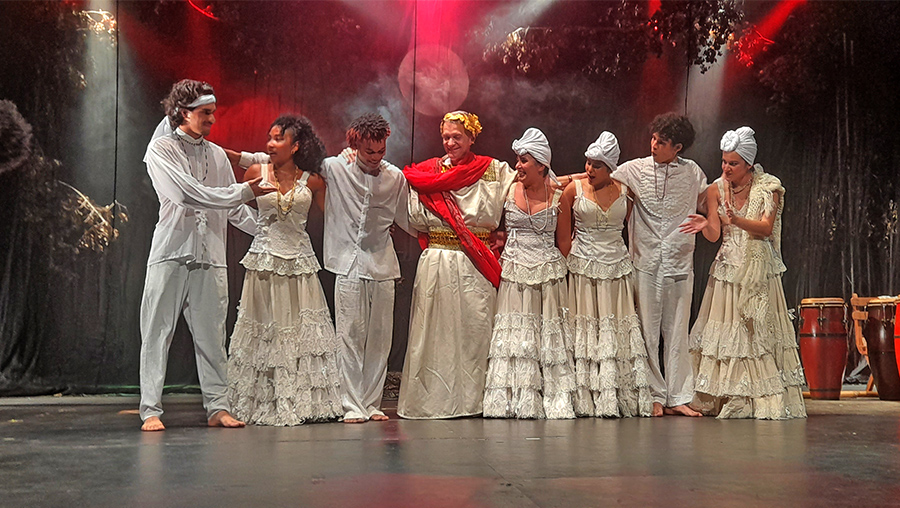
The actor, professor, and stage director Fernando Hechavarría received the National Theater Award last Saturday on the stage of Trianón Theater, homebase of the Teatro El Público company. The ceremony coincided with the final exam for graduating students of the Corina Mestre National Theater School, Fernando's students. Among those in attendance were Elier Ramírez Cañedo, Deputy Head of the Ideological Department of the Central Committee of the Party; Alpidio Alonso, Minister of Culture; Marta Bonet, President of the UNEAC (National Association of Writers and Artists of Cuba); and a large number of performing artists from various generations. The performance was directed by Carlos Díaz, also a National Theater Award winner.
We reproduce the words of praise for the actor, written by journalist Yuris Nórido and read on stage by young actors from his company:
There’s no better stage, dear Fernando, for you to receive this well-deserved National Theater Award than your theater, your stage, your company. Here you have established yourself in characters, in performances that have long been part of the essential history of the Cuban stage. You are an actor of the broadest range; you have mastered all means of expression. Perhaps your greatest popularity is due to television, to your roles in so many soap operas and television series. For many, you will always be, for example, Nacho Capitán in Tierra Brava.
But without diminishing that achievement, we can say with certainty: Fernando Hechavarría is, first and foremost, a man of theater. Here he has reached his fullest expression. Here his extraordinary talent has crystallized. Here he has set the standard for rigor and professional ethics. Because Fernando Hechavarría, in the most luminous sense of the term, is a master.
This award recognizes an exceptional career with two undeniable milestones: Teatro Escambray and Teatro El Público, companies to which you have dedicated a significant part of your creative life. These are not mere affiliations on a résumé: they are ethical and aesthetic territories that have shaped you and which you, in turn, have marked with your own imprint.
The first is perhaps the most solid reference point in Cuba for theater in, for, and by the community. There, art became a tool for social dialogue, a mirror of rural realities, a space for shared reflection. In that context, you learned—and taught—that theater is not ornamentation, but a need.
The second has been a celebration of grand stage performance, a laboratory of risk, irreverence, and beauty. In it, you have drawn from the universal heritage and the roots of our celebrations and dramas. You have journeyed through classics and contemporary works, through drama and farce, through provocation and poetry, always with the absolute dedication of someone who understands that every performance This performance is unique.
You have risen to the challenge in both roles. With ample credentials, you have been equally at home as a young student in a rural school and an anonymous villager in the hills; equally at home as a Roman emperor blinded by power and a fashion designer haunted by his demons. This versatility sets you apart from your contemporaries and confirms your rare capacity for transformation.
For you, the gender, age, origin, or circumstances of your characters have never been insurmountable barriers. Everything revolves around a truth—your truth—on stage. The way you study each role, the research that precedes the productions, the frank and demanding dialogue with directors, have resulted in characterizations that transcend the mask and the costume.
Let’s just recall your Petra von Kant in Carlos Díaz's unforgettable production for El Público. In some performances you wore a beard and mustache, and yet the audience didn't see a man in drag: they saw and felt a powerful, wounded, complex woman, assertive beyond the makeup. That is the magic of theater that you have embodied, the suspension of all boundaries when theatrical truth prevails.
You have talent to spare, Fernando, but you know that genius without guidelines is a runaway horse. You honor rigor as the supreme form of respect for the stage, the process, and the audience. You have embraced a professional ethic that has guided you for decades and that you try to pass on, with patience and loving severity, to new generations.
Because you are a teacher, we emphasize not only for your complete mastery of your art and your example of perseverance, but also in the classroom and in the rehearsal room. Your work at the Corina Mestre National School of Theater has been essential in the training of actors who today recognize you as an essential role model.
Alongside Carlos, alongside your colleagues, here at Trianon theater, you defend the usefulness and beauty of art every day, even in times of hardship and exodus.
Just a few weeks ago, you and your students presented a production based on Shakespeare's texts; in El Público's most recent production, Requiem for Yarini, you were veiled as an enigmatic lady. Now you will receive another ovation. And although it may seem a cliché, that is the greatest recognition for you. An actor is made and honed through interaction with people. The rest is just glitz and glamour. Although, of course, you don't mind the glamour either.
Congratulations, dear Fernando. We can and must still do much more.
Add new comment