
Cuba Updates Educational Measures to Ensure Academic Continuity Amid Energy Crisis
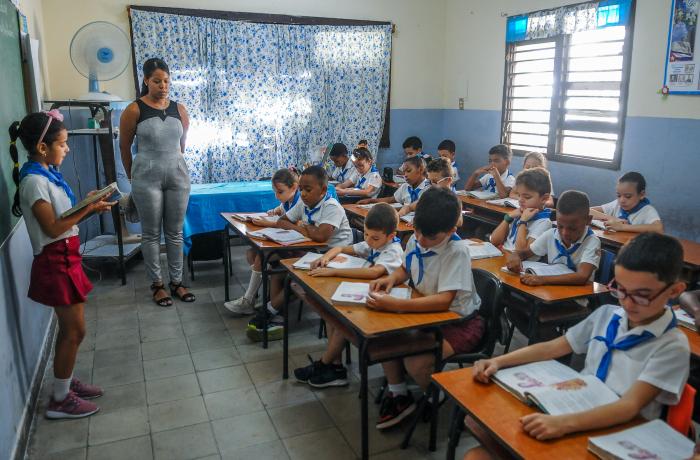
Recorrido por instituciones de educación, escuela Primaria Combatientes de Bolivia, municipio Plaza de la Revolución. Foto: José Manuel Correa
In light of the prolonged energy situation facing the country — a direct consequence of the petroleum blockade imposed by the United States — Vice Prime Minister Eduardo Martínez Díaz announced updated measures for the education sector during a broadcast of the television program Mesa Redonda. The official stated that previously announced policies have been revised in accordance with principles that have guided the government's decision-making throughout the crisis.
Martínez Díaz emphasized that authorities are maintaining a balance between academic rigor and the flexibility and decentralization that the current context demands, "preserving the highest level of professionalism possible and the bond between teachers and students," along with ongoing dialogue among all participants in the educational process.
Minister of Education Naima Trujillo Barreto elaborated on the specific adjustments by level. In early childhood education, activities have in some cases been consolidated into a single daily session. Special education continues to be prioritized in all its forms — including specialized institutions, general education settings, and hospital or outpatient programs.
For middle and high school students, described as presenting "complexities in terms of enrollment and operations," activities have continued with an emphasis on core subjects and curriculum adaptations suited to local conditions.
With respect to twelfth-grade students, in-person instruction will be maximized to ensure adequate preparation for university entrance examinations and other higher education access mechanisms. To that end, Trujillo Barreto announced that the evaluative calendar has been adjusted, "granting 15 additional days starting next Monday for regional authorities to schedule final examinations." University entrance examinations have been postponed to the beginning of June.
In the area of higher education, Minister Walter Baluja García reported that curricular modifications to study programs have been authorized in order to sustain academic activity across the university community. He noted that students in daytime programs may continue to be placed in teaching units or workplace entities within their territories to carry out professional practice and other academic activities, with whatever adjustments prove necessary.
Baluja García further indicated that evaluations will be reduced to those deemed essential, proficiency examinations may be convened outside their standard timeframes, and graduation exercises — in any of their formats — may be conducted either in person or virtually, depending on the specific characteristics of each program and territory.
Add new comment